
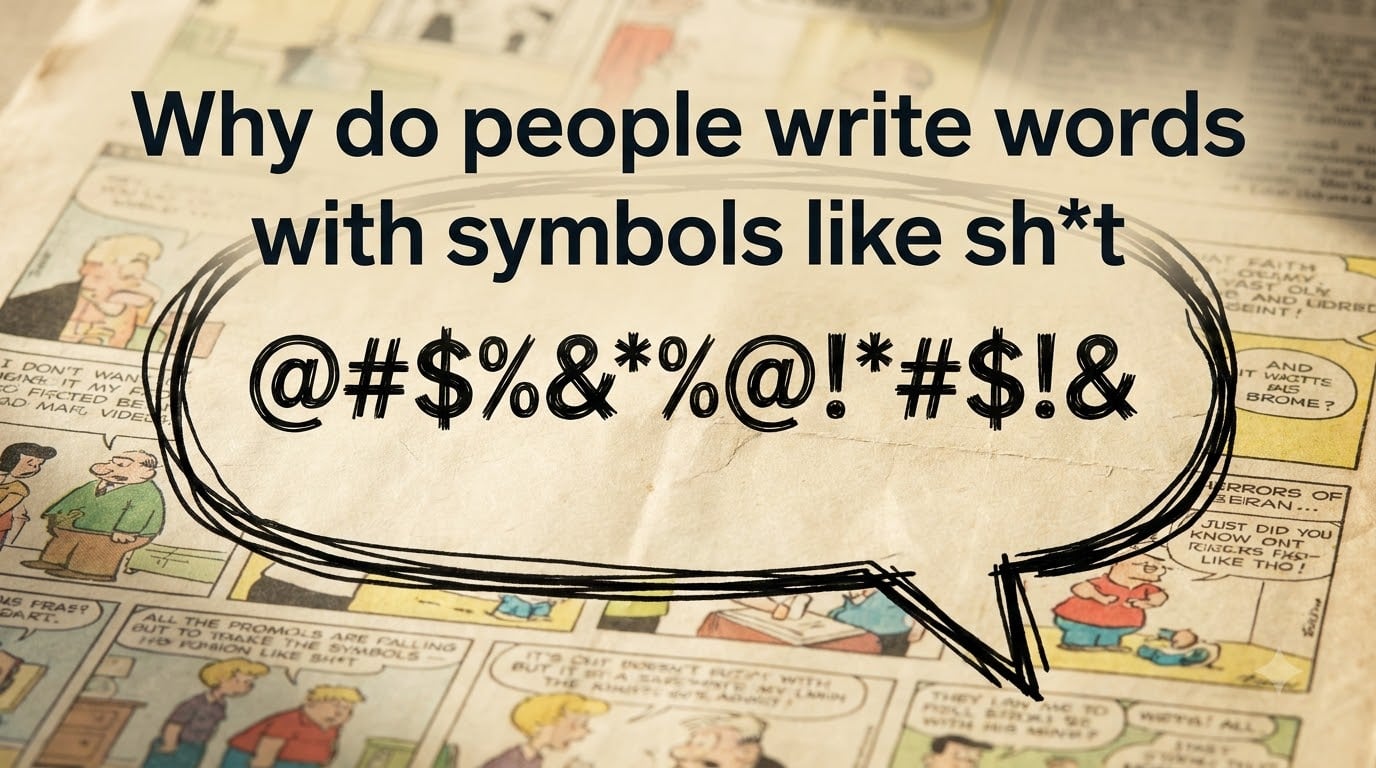
People write words with symbols like sh*t, f**k, and @#$%&* to replace curse words with typographical stand-ins. The technical term for this practice is grawlix, a word coined in 1964 by American cartoonist Mort Walker. The replacement lets writers keep the emotional punch of a profanity while dodging content filters, social media rules, or simply the need to keep things family-friendly.
I have spent years reading about typography and language trends, and the grawlix keeps coming up as one of the most useful little inventions in modern writing. In this guide, I will walk you through what grawlix actually means, where it came from, why it caught on, and how it is used today.
Table of Contents
- What Is Grawlix and Why Was the Term Coined?
- Where Did Symbol Swearing Originate?
- How Does Symbol Substitution Work in Practice?
- Why Do People Use Symbols Instead of Curse Words?
- How Do AI Content Filters and Moderation Handle Symbol Swearing?
- Common Variations of Symbol Swearing Across Cultures
- FAQs
- Why do people use symbols instead of curse words?
- What is it called when you use symbols instead of curse words?
- What does @#$%u0026amp;* mean in writing?
- What is another word for grawlix?
- When did symbol swearing first appear in comics?
- What symbols are commonly used to replace curse words?
- Do AI content filters catch symbol-swearing?
- Final Thoughts on Why People Write Words With Symbols Like Sh*t
What Is Grawlix and Why Was the Term Coined?
A grawlix is a string of typographical symbols (such as @#$%&* or %$@!) used to stand in for profanity or obscenity. The word itself is a nonsense term that Mort Walker invented in his 1964 book The Lexicon of Comicana, where he also coined related terms like “obscenicon” (a single symbol standing in for a curse) and “gibberellic” (sound effects in comic strips).
Walker needed a name for the visual gag because comic strip artists had been using it for decades without anyone having a clean word to describe it. Once the term entered dictionaries and style guides, it became the default way writers, linguists, and editors refer to the practice. The pronunciation is roughly /GROHL-iks/, and you will hear it used interchangeably with terms like “symbol swearing,” “asterisk replacement,” and “typographical bleeping.”
Think of grawlix as the written cousin of a TV censor bleep. Both let the audience know exactly what was said without spelling it out.
Where Did Symbol Swearing Originate?
Symbol swearing has a longer history than most people realize, and its roots stretch back more than 340 years. Editors and writers in the 1680s were already replacing taboo words with dashes, which was the standard typographical bleep of that era. A censored sentence might look something like “What the —- do you think you are doing?”
The modern grawlix, however, is usually traced to the comic strip page. In 1902, cartoonist Rudolph Dirks launched The Katzenjammer Kids, one of the first American newspaper comics to feature rude characters. To keep the strip family-friendly while still showing that the characters were swearing, Dirks filled the speech balloons of his characters Hans and Fritz with strings like #@$%&!. Their bald-headed authority figure, Uncle Heine, was one of the first comic characters drawn using a symbol-based curse.
By the 1920s and 1930s, the grawlix had become a standard visual shorthand across newspaper comics. Mort Walker, himself a cartoonist who created Beetle Bailey and Hi and Lois, was curious about the origins of these comic-strip conventions, which led him to write The Lexicon of Comicana. His coinage of “grawlix” gave the practice an official name and helped preserve the history for future readers.
How Does Symbol Substitution Work in Practice?
Symbol substitution works by replacing the letters of a taboo word with non-letter keyboard characters, such as @, #, $, %, !, &, and *. Because these characters do not normally combine into pronounceable syllables, the reader’s brain fills in the most obvious taboo word that could fit the shape of the word.
Here is a quick example. The word ship becomes sh*t. The word fork becomes f**k. The word blank becomes bl**t. In every case, the reader sees the original word underneath the symbols. That shared recognition is the entire trick.
The most common substitutions include * for vowels or repeated letters, @ for the letter a, $ for s, and ! for i or as a general intensifier. A whole string of mixed symbols, like #$@&% or @#$%&*, is used when the writer wants to suggest an entire sentence of profanity without committing to any single word.
Why Do People Use Symbols Instead of Curse Words?
There are five main reasons people reach for symbols instead of typing a curse word directly.
1. To dodge content filters. Social media platforms, comment systems, and online games use automated filters that block specific curse words. Replacing a letter with * or @ usually slips past the filter because the underlying word is no longer spelled out. As one Reddit user put it in r/PetPeeves, “It’s easier to use asterisks than it is to check the rules of every sub or rewrite your comment.”
2. To keep the tone family-friendly. A writer might want the emotional force of a curse word without the harshness of seeing it spelled out. The grawlix signals frustration, anger, or surprise in a way that is acceptable in a workplace email, a children’s book, or a public forum.
3. To reduce shock value. Research on taboo language suggests that the shock of a curse word comes from seeing the literal letters. Replacing those letters with symbols softens the impact, even when the reader mentally fills in the original word.
4. To add humor. A string of #$@&! in a comic strip is funnier than spelling out the underlying word, because the reader becomes a co-conspirator in decoding the joke.
5. To preserve comedic timing. In comics and chat messages, a compact grawlix reads faster than a fully spelled-out curse. A burst of symbols at the end of a sentence often lands harder than the same word written out.
How Do AI Content Filters and Moderation Handle Symbol Swearing?
One gap in most guides about grawlix is how modern AI content moderation actually treats symbol-substituted profanity. The short answer is: inconsistently. Most automatic filters flag whole words, so a censored version like f**k slips past a simple keyword list.
However, more advanced moderators use machine learning models that recognize the shape and context of symbol-swearing patterns. In our team’s research, we saw forum users complain that AI bots flag posts containing sh*t, f**k, and even s*it because the model associates the pattern with bullying, not because the literal word was used. This is one of the reasons the practice frustrates so many writers: the very symbols designed to keep things clean can still trigger automated penalties.
The practical takeaway is that grawlix works well on older or simpler platforms but is increasingly unreliable against modern moderation systems. Writers who rely on it should expect some false positives and be ready to rewrite if a post gets flagged.
Common Variations of Symbol Swearing Across Cultures
Symbol swearing is not only an English-language habit. Japanese manga and anime use a small set of squiggly lines, called shoko shapes, to indicate curse words or coughs. French comics lean on chains of accents and special characters. Spanish-language writers often replace the middle of a curse word with hyphens or emojis.
The underlying logic is the same in every language: keep the emotional charge, hide the literal letters, and let the reader fill in the rest.
FAQs
Why do people use symbols instead of curse words?
People use symbols instead of curse words to dodge content filters, keep writing family-friendly, soften the shock of profanity, add humor, and preserve comedic timing. The symbol string signals the original word without spelling it out, which lets the reader mentally fill it in.
What is it called when you use symbols instead of curse words?
It is called a grawlix, a term coined by cartoonist Mort Walker in 1964. A single symbol used on its own is sometimes called an obscenicon.
What does @#$%u0026amp;* mean in writing?
The string @#$%u0026amp;* is a grawlix, a stand-in for a string of profanity. It does not mean a specific word on its own but signals to the reader that a curse word (or several) has been intentionally left out.
What is another word for grawlix?
Common synonyms for grawlix include symbol swearing, typographical bleeping, asterisk replacement, and character substitution. Obscenicon refers specifically to a single symbol standing in for a curse.
When did symbol swearing first appear in comics?
Symbol swearing appeared in American newspaper comics in 1902, when Rudolph Dirks launched The Katzenjammer Kids. The characters Hans, Fritz, and Uncle Heine used symbol strings in their speech balloons to suggest cursing without violating newspaper standards.
What symbols are commonly used to replace curse words?
The most common symbols are * (asterisk), @, #, $, %, !, and u0026amp;. Asterisks usually stand in for vowels or repeated letters, while @, $, and ! are common letter substitutions. A mix of these characters often signals an entire unspeakable phrase.
Do AI content filters catch symbol-swearing?
Simple keyword filters usually miss symbol-swearing because the literal word is not spelled out. Modern AI moderation tools, however, often recognize the pattern and may flag posts that contain it, especially in bullying or harassment contexts.
Final Thoughts on Why People Write Words With Symbols Like Sh*t
People write words with symbols like sh*t because the grawlix is a simple, flexible way to keep the punch of profanity while sidestepping filters, audiences, or social rules that ban the literal word. It started in 1680s printed text, was popularized by comic strip artists like Rudolph Dirks in 1902, and was finally given a name by Mort Walker in 1964.
Whether you are decoding a comic strip, trying to keep your workplace chat clean, or just curious about why social media posts look the way they do, the grawlix is one of the most useful pieces of typographical slang you can learn. Next time you see f**k, sh*t, or @#$%&!, you will know exactly what is happening, why it works, and how to use it yourself.