
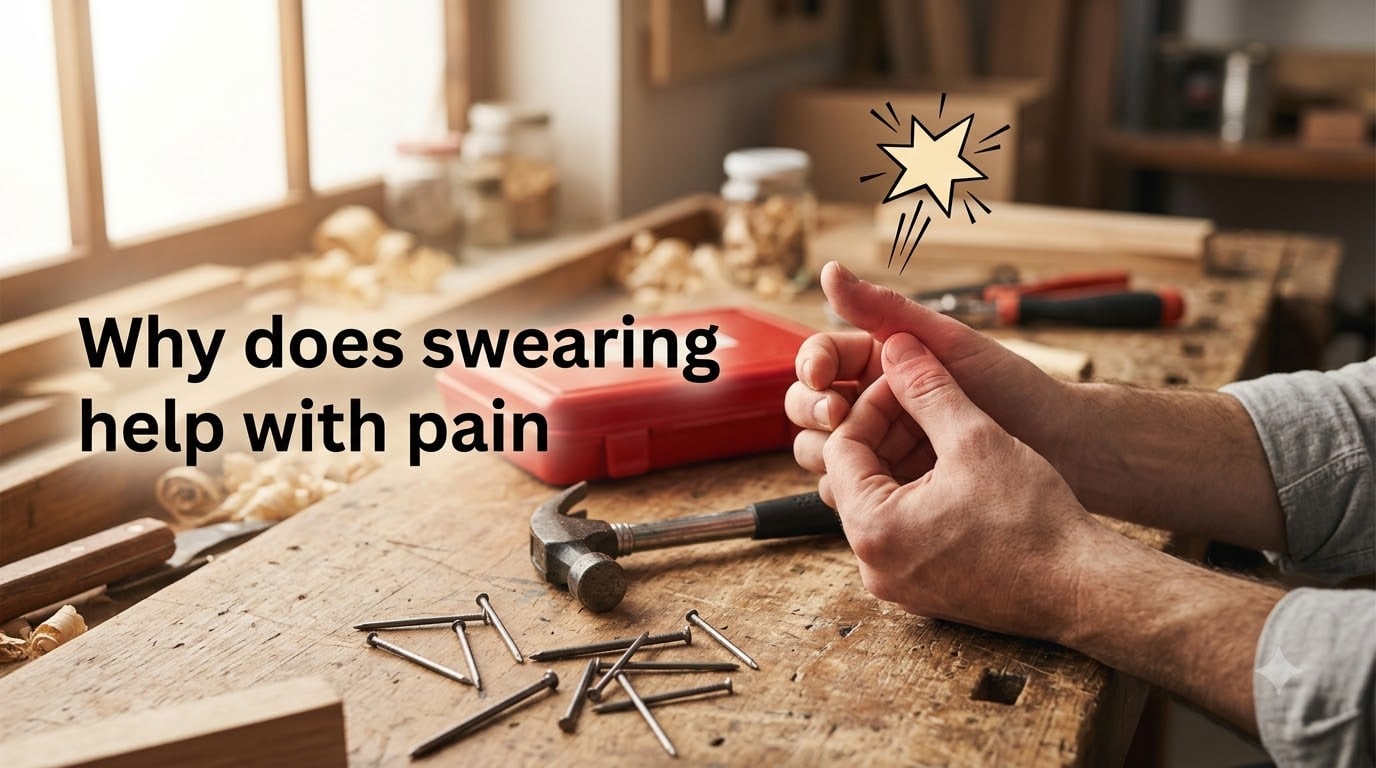
Why does swearing help with pain? The answer surprised me when I first read the research: dropping a well-placed F-bomb when you stub your toe can actually make the hurt feel less intense. Science has put this to the test, and the results are oddly fascinating. Studies at Keele University showed that swearing can increase pain tolerance by roughly 30-33%, and a 2024 review in Frontiers in Psychology confirmed this works across multiple experiments. But the how behind it is where things get really interesting.
In this guide, I’ll walk you through the fight-or-flight mechanism that links profanity to pain relief, the role of your amygdala and adrenaline, what the original research actually found, and why some swear words work better than others. I’ll also cover practical ways to use this knowledge (or whether you even should).
Table of Contents
- How Does Swearing Help With Pain?
- The Fight-or-Flight Response Explained
- What the Research Shows
- Why Traditional Swear Words Work Better Than Made-Up Ones
- Does Daily Swearing Reduce the Pain-Relief Effect?
- Can Swearing Help With Social and Emotional Pain?
- Practical Ways to Use Swearing for Pain Relief
- Frequently Asked Questions
- The Bottom Line on Swearing and Pain
How Does Swearing Help With Pain?
Swearing helps with pain by triggering a fight-or-flight stress response that activates your amygdala, flooding your body with adrenaline and natural endorphins. This sudden chemical surge raises your pain threshold and tolerance, making the same hurt feel more manageable. The phenomenon has a scientific name: the hypoalgesic effect of swearing.
In plain English, swearing gives your brain a tiny controlled shock. That shock shifts your nervous system out of its normal resting state and into a heightened alert mode. During that shift, your body releases its own painkillers, the same chemicals that allow soldiers to keep fighting after serious injuries and athletes to push through shattered bones to finish a race.
The Fight-or-Flight Response Explained
The fight-or-flight response is your body’s ancient alarm system, designed to help you survive sudden threats. When you experience pain, your brain quickly decides whether to confront the threat or run from it. Swearing slides right into that decision-making process and triggers the alarm manually.
How Your Brain Reacts to Pain and Profanity
When you stub your toe or jam your finger, the signal reaches your brain in milliseconds. At the same time, profanity gets processed differently from regular language. Researchers have found that swear words activate the right hemisphere of the brain, while normal words tend to be processed on the left. That right-hemisphere activation lights up the same emotional circuits that handle fear and alarm.
So when you curse after hurting yourself, your brain treats the situation like a small emergency. It dumps stress hormones into your bloodstream, raises your heart rate, and diverts attention away from the actual pain. By the time you finish your sentence, your body has already started producing natural painkillers.
The Role of the Amygdala
The amygdala is your brain’s threat detector. It’s a small almond-shaped structure deep in the temporal lobe, and its job is to spot danger fast. When you swear after an injury, the amygdala treats the profanity as a signal that something serious is happening.
This is the key step. The amygdala triggers the release of adrenaline and noradrenaline from your adrenal glands. Those hormones prepare your muscles for action, sharpen your focus, and, importantly, blunt your perception of pain. A 2009 Keele University study by Richard Stephens and colleagues found that people who swore during the ice water test showed significantly higher heart rates than those who stayed silent, which is a clear sign the amygdala’s alarm system had fired.
Adrenaline as a Natural Painkiller
Adrenaline (also called epinephrine) is one of the most powerful pain-blocking chemicals your body produces. The same adrenaline rush that lets a parent lift a car off a child is the one that lets you keep hammering a nail after smashing your thumb.
Adrenaline works by binding to receptors in your spinal cord and brain that normally relay pain signals. When those receptors are flooded with adrenaline, the pain message gets partially blocked. Your nerves still send the signal, but your brain interprets it as less urgent. That’s why swearing during an injury doesn’t make the pain vanish; it just makes the pain feel more distant and easier to push through.
What the Research Shows
The science behind swearing and pain relief is unusually well-documented for such a colorful topic. Researchers have been running controlled experiments on this since 2009, and the results keep coming back the same way.
Keele University Studies (2009 and 2011)
The original breakthrough came from psychologist Richard Stephens at Keele University in the UK. In 2009, he and his team asked 67 undergraduate students to submerge their hands in ice water for as long as they could tolerate. One group repeated a swear word of their choice, while the other repeated a neutral word describing a table.
The swearing group kept their hands in the ice water significantly longer (about 8 seconds longer on average) and reported the pain as less intense. That pain tolerance boost translated to roughly a 30-33% increase compared to the neutral-word group. The follow-up 2011 study, this time with a larger sample, found the same effect plus a heart rate increase during swearing, confirming the fight-or-flight angle.
Stephens has also pointed out that the 2011 study showed swearing raised heart rate by about 5 beats per minute, when you’d normally expect heart rate to drop during cold water immersion. That’s strong evidence the body was literally shifting into emergency mode.
The Ice Water Cold Pressor Experiment
The cold pressor test is the standard lab tool for measuring pain tolerance. You put your hand in near-freezing water and time how long you last. It’s uncomfortable, uncomfortable within seconds, and difficult to fake. Most studies on swearing and pain rely on this exact setup because it isolates physical pain from emotional or social factors.
Across multiple studies, cold pressor tests have consistently shown that swearing extends endurance by 30-50 seconds on average. That might sound small, but in real situations like waiting for a medical procedure, finishing a hard workout, or enduring an injury, half a minute of extra tolerance matters a lot.
Recent 2024 Frontiers in Psychology Review
The most comprehensive modern review appeared in 2024 in Frontiers in Psychology. The authors looked at every controlled study they could find on the hypoalgesic effects of profanity. Their conclusion: swearing has produced consistent, measurable pain reduction across more than a dozen experiments involving hundreds of participants.
This mini-review also pointed out something important. The mechanism isn’t just distraction. If swearing worked only by diverting attention, then any strong word would do the job. But the research shows it doesn’t. That’s why the researchers now favor the emotional arousal hypothesis: swearing works because it produces a strong negative emotional response, and that response triggers the body’s stress-induced analgesia system.
Why Traditional Swear Words Work Better Than Made-Up Ones
Here’s where the science gets weird and wonderful. Swearing only works if you use a real swear word, the kind you’d actually mutter after a stubbed toe. Invented nonsense words don’t do the job, even if you shout them at the top of your lungs.
The Novel Swear Words Study
Researchers at Keele University ran a clever follow-up test in 2017. They taught participants a fake swear word, like “fouch” or “twizpipe,” and had them use it during the cold pressor test. The results were striking: made-up swear words produced no measurable pain relief compared to neutral words.
The same study did find one twist. Fake words could produce a small pain-reducing effect if they were paired with a genuinely emotion-evoking concept. But generally, the effect requires real profanity, words that carry actual social and emotional weight in your brain.
What Makes a Word Profane Enough to Help
For swearing to trigger the pain-relief response, the word needs three things: it must be emotionally charged, socially taboo, and deeply learned. Traditional profanity meets all three criteria because it’s usually acquired in childhood through emotional contexts, before you even understand what the words mean.
Steven Pinker, the cognitive scientist, has written that curse words tend to be learned separately from normal language, often stored in the brain as raw emotional data rather than abstract symbols. That emotional storage is what gives them their power. When you yell a real swear word, your amygdala lights up. When you yell a nonsense word, your language centers do the work instead, and the alarm never goes off.
Does Daily Swearing Reduce the Pain-Relief Effect?
Yes, swearing frequently could dull its pain-relief power. The 2011 study by Stephens found that people who reported swearing less in daily life got the biggest pain tolerance boost from profanity during the cold pressor test. People who cursed frequently in everyday conversation showed a smaller effect.
This makes sense if you think about the emotional arousal explanation. If a swear word has become emotionally stale to you because you use it constantly, it won’t trigger the same alarm response. The amygdala pays attention to surprise and intensity. Words you’ve heard yourself say a thousand times won’t deliver that spark.
So the trick is to save your strongest words for when you really need them. That doesn’t mean you should never swear. It just means that on the day you slam your finger in a car door, the people who don’t curse constantly will get more relief from the same word than those who profanity has lost its edge.
Can Swearing Help With Social and Emotional Pain?
Swearing doesn’t just work on physical pain. There’s strong evidence it helps with social and emotional pain too, the kind that comes from rejection, embarrassment, or failure. This is where the science gets really interesting for everyday life.
Social Rejection and Emotional Distress
Emma Byrne, a neuroscientist and author of “Swearing Is Good for You,” has pointed out that the same brain regions that process physical pain also process social rejection. That’s why being left out or embarrassed can feel like a literal wound. Because swearing activates the same fight-or-flight chemicals that blunt physical pain, it can have a similar dulling effect on emotional pain.
Studies have shown that people who swear after a frustrating event report lower stress levels and recover faster emotionally than those who stay polite. The strong language acts like a pressure valve, releasing the tension before it can build into something worse.
Swearing as a Social Bonding Tool
Swearing also strengthens social bonds, which is itself a form of emotional pain relief. Research has found that people who swear together report higher levels of trust and group cohesion. The shared taboo creates a sense of in-group belonging, and that sense of belonging counteracts the loneliness and isolation that often magnify pain.
One study even showed that witnesses rated workers who used profanity as more trustworthy and authentic than those who stayed squeaky clean, as long as the swearing wasn’t directed at anyone personally. That authenticity is a form of emotional safety, and emotional safety reduces the chronic stress that amplifies pain over time.
Practical Ways to Use Swearing for Pain Relief
So can you actually use this in real life? Mostly yes, with a few caveats. The science suggests there are smart ways to put this knowledge to work.
When to Swear for Maximum Benefit
The effect works best for acute, short-term pain: bangs, stings, burns, dental work, medical procedures, tough workouts. If you know pain is coming, deliberately swearing beforehand can help you push through it. Athletes who swear during heavy lifts report being able to squeeze out a few extra reps, and the same principle applies to anyone facing a painful moment.
For best results, choose a swear word that feels genuinely strong to you. The ice water studies worked regardless of which specific word participants chose, but the effect was strongest when the word felt appropriate. If a word doesn’t actually offend you, it won’t have the same power.
Limitations and Considerations
Swearing doesn’t work for chronic pain. The mechanism relies on a sudden adrenaline spike, and chronic pain conditions don’t respond to adrenaline the same way. If you live with fibromyalgia, arthritis, or ongoing back pain, swearing might provide a brief distraction, but it won’t replace proper treatment.
Context matters too. Swearing at a job interview won’t help your career. Swearing at a child won’t help your parenting. The pain-relief effect is real, but it only works when the swearing is appropriate for the situation. Save it for the moments when no one important is listening, and you’ll get the physiological benefit without the social cost.
One last note: swearing during medical procedures is actually encouraged in many modern pain management guides. Nurses and doctors have seen this work firsthand for years. The research now just explains why.
Frequently Asked Questions
Why do you swear when you get hurt?
People swear when they get hurt because profanity triggers the body’s fight-or-flight response. That response activates the amygdala, floods your system with adrenaline, and temporarily raises your pain tolerance by roughly 30%. It is the body’s natural emergency brake working through language.
Why does yelling relieve pain?
Yelling, including swearing, relieves pain because it provokes a strong emotional arousal that triggers stress-induced analgesia. When you shout, your amygdala interprets the situation as urgent, releasing adrenaline and endorphins that blunt the pain signal before it reaches full awareness. The louder and more emotionally charged the outburst, the stronger the chemical response.
Does swearing help relieve pain?
Yes, swearing helps relieve pain in controlled studies. Participants who repeated swear words during an ice water test kept their hands submerged about 30-33% longer than those who repeated neutral words. The effect appears in multiple peer-reviewed studies and is strongest in people who do not swear frequently in daily life.
Do people who swear have higher pain tolerance?
Counterintuitively, the opposite is true. People who swear most often in daily life get the smallest pain-relief boost from profanity. The effect is strongest in people who rarely curse, because the amygdala responds more strongly to surprise and emotional intensity. Overuse makes curse words emotionally stale.
What is the hypoalgesic effect of swearing?
The hypoalgesic effect of swearing is the scientific term for the pain-reducing effect of profanity. Hypoalgesic means producing a reduced sensitivity to pain. The effect was first formally documented by Keele University researchers in 2009 and has been replicated in multiple studies since, including a 2024 Frontiers in Psychology review.
The Bottom Line on Swearing and Pain
Why does swearing help with pain? Because your brain treats profanity as a signal to flip into emergency mode. That emergency mode dumps adrenaline into your system, raises your heart rate, and produces a measurable analgesic effect. Real research from Keele University, peer-reviewed studies, and a 2024 review in Frontiers in Psychology all confirm it: swearing can boost pain tolerance by 30-33%, and yes, you read that right.
The catch is that the effect only works for traditional profanity, not made-up words, and it’s strongest in people who don’t swear constantly. But for occasional acute pain, whether you’re hitting your thumb with a hammer, grinding through a hard gym session, or bracing for a medical procedure, a well-placed curse word is a free, instantly available pain reliever that requires no prescription and no equipment.
So the next time you stub your toe and the profanity comes flying out, give yourself a small nod of approval. Your brain is doing exactly what evolution designed it to do. It’s switching gears, releasing its own painkillers, and helping you push through. That instinct to curse, it turns out, is one of the most underrated tools in your body’s pain-management kit.