
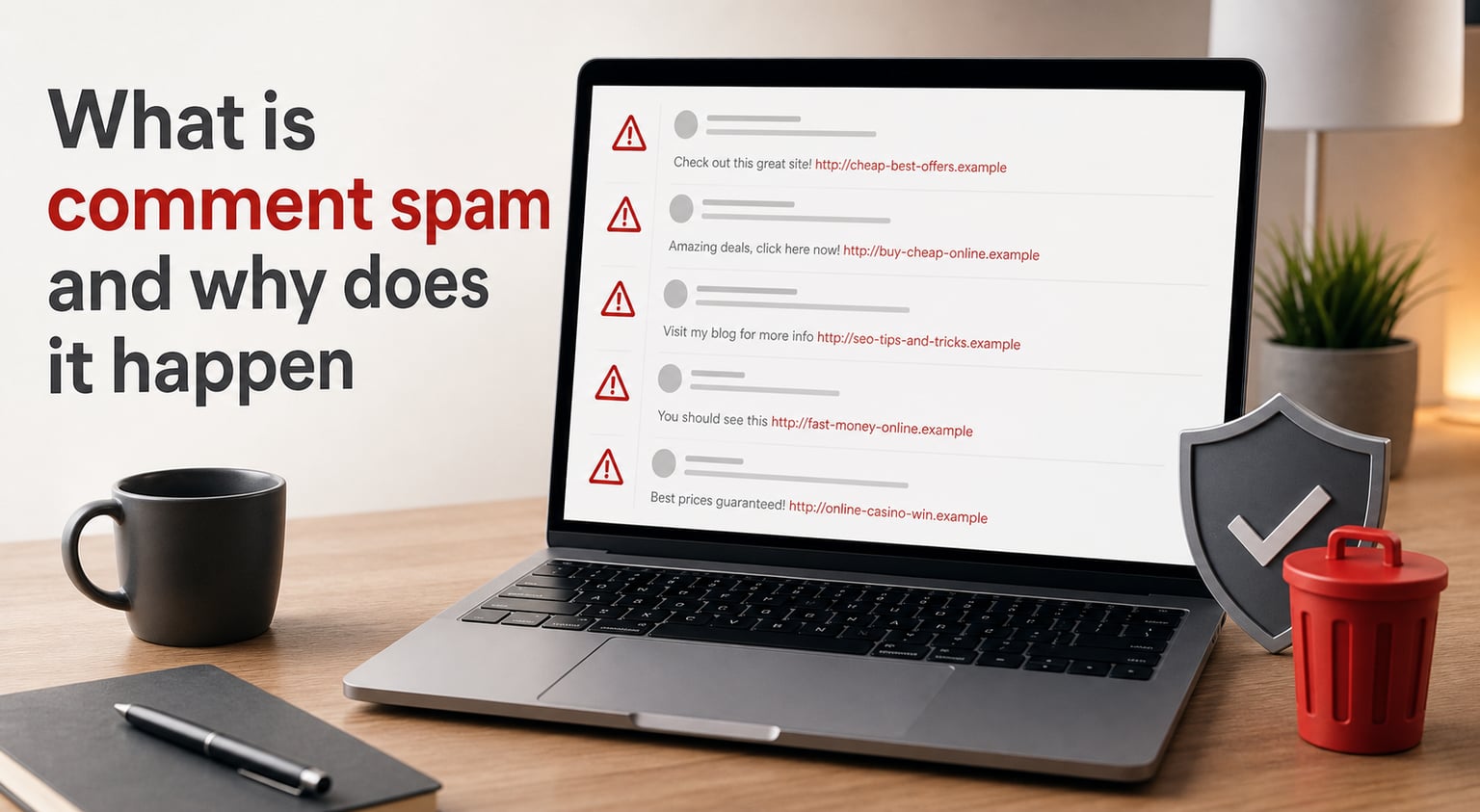
If you have ever run a blog, managed a social media page, or published a YouTube video, you have probably encountered comment spam. Those weird messages about discount shoes, cryptocurrency giveaways, and mysterious links that have nothing to do with your content show up everywhere. In this guide, I will break down what comment spam is, why it happens, who is behind it, and what you can do about it.
Comment spam is one of the most persistent problems on the internet, and it affects everyone from solo bloggers to massive platforms. Whether you are dealing with WordPress spam comments on a brand new website or fighting off spam bots in your YouTube comment section, understanding the mechanics behind it is the first step toward protecting your content and your audience.
Table of Contents
What Is Comment Spam?
Comment spam refers to unsolicited, irrelevant, or promotional messages posted in the comment sections of blogs, social media posts, forums, and video platforms. These comments exist not to contribute to a discussion but to serve the spammer’s agenda, which usually involves driving traffic to an external website or manipulating search engine rankings.
The concept is closely tied to a practice called spamdexing, which is the deliberate manipulation of search engine indexes through deceptive tactics. When spammers drop links to their own websites inside comments on other sites, they are attempting to build what are known as backlinks. Search engines historically used backlinks as a signal of a page’s authority and relevance. The more sites linking to a page, the higher it tended to rank. Spammers exploited this by flooding comment sections across the web with links pointing back to their own domains.
Any comment that does not genuinely add to the discussion can be considered spam. If someone leaves a comment purely to promote a product, insert a link, or generate fake engagement, it falls under the comment spam umbrella regardless of how polite or well-written it might appear.
Comment spam takes many forms. Some of it is blatantly obvious, like gibberish text with a suspicious link attached. Other types are more subtle, using generic praise such as “Great post, really helpful!” followed by a link to a completely unrelated website. The goal is always the same: to sneak past moderation filters and get the link in front of real human eyes or search engine crawlers.
Why Does Comment Spam Happen?
Comment spam happens because it works, or at least it used to work well enough that the practice became deeply entrenched in the world of black-hat SEO. The motivations behind comment spam break down into several distinct categories, and understanding each one helps explain why this problem refuses to go away.
Search Engine Manipulation Through Backlinks
The primary reason comment spam exists is search engine manipulation. For years, backlinks were one of the most powerful ranking factors in Google’s algorithm. Every link pointing to a website was essentially a vote of confidence in that site’s content. Spammers realized they could artificially inflate their own rankings by posting thousands of links across open comment sections on blogs and forums.
While Google introduced the nofollow attribute in 2005 to combat this, spammers continue to pursue comment links. Some smaller search engines and older crawlers still follow these links, and certain blog configurations fail to apply nofollow correctly. The sheer volume of automated posting means that even a small percentage of successful placements can generate results for the spammer.
Traffic Hijacking
Not all comment spam is about search rankings. A significant portion is simply about stealing traffic. By posting attention-grabbing comments with links on high-traffic pages, spammers can redirect real human visitors to their own websites. A comment on a popular YouTube video or a viral Facebook post can generate clicks from curious users who do not realize they are clicking on a malicious or promotional link.
This tactic is especially common on social media platforms where comments appear in real time and can be seen by thousands of people before moderators catch them.
Promotional Spam and Product Marketing
Many spam comments are essentially free advertising. Instead of paying for ad space, spammers post promotional messages in comment sections related to their niche. You will often see this on product review blogs, tech forums, and social media posts about trending topics. The comment might advertise replica goods, supplements, software downloads, or financial services.
Because comment sections are free and accessible, there is essentially no cost to the spammer for attempting this. Even if 99 percent of the comments get deleted, the one percent that survive can still generate sales.
Malware Distribution and Phishing
Some comment spam has a darker purpose: distributing malware or directing users to phishing sites. These comments typically contain shortened or disguised links that lead to infected pages. Once a user clicks through, their device may be compromised or their personal information stolen.
Forum users on Reddit have shared real frustration about encountering spam comments containing malicious links, particularly on platforms where moderation is lighter or automated filters are less aggressive.
Affiliate Link Building
Affiliate marketers sometimes use comment spam as a low-effort way to spread their referral links. By pasting affiliate links into comments on relevant blog posts or videos, they attempt to earn commissions from users who click through and make purchases. This is a violation of most affiliate program terms of service, but enforcement is difficult.
Examples of Comment Spam
To recognize comment spam, it helps to see what it actually looks like. Here are the most common patterns I have encountered across different platforms.
WordPress Blog Comment Spam
WordPress is one of the biggest targets for comment spam because of its massive market share and open comment system. Typical WordPress spam comments include generic praise paired with a link. For example, you might see something like: “This is a really well written article. I will be sure to bookmark it and come back to read more of your useful info. Thanks for the post. Visit my homepage: [link].” The comment adds zero value and exists solely to plant a backlink.
Reddit users in the WordPress community report getting spam comments within hours of launching a new website, which shows how aggressively bots scan for fresh targets.
YouTube Spam Comments
YouTube comment spam tends to be more visually disruptive. Common examples include fake giveaway announcements like “I just won an iPhone from [channel name]. Click here to claim yours!” followed by a suspicious link. Another recurring pattern is bot accounts pasting identical comments across dozens of videos to drive traffic to external sites or scam pages.
Members of the NewTubers community on Reddit frequently discuss the challenge of dealing with spam bot comments on YouTube, especially on videos that start gaining traction.
Facebook and Instagram Comment Spam
On Facebook and Instagram, comment spam often appears as fake engagement. Bots post flattering comments on influencer posts, then include links to replica stores or cryptocurrency schemes. Instagram in particular has struggled with bot accounts leaving emoji-heavy comments that appear genuine at first glance but contain promotional links in the user’s profile or bio.
Interestingly, Facebook users on Reddit have also complained about the opposite problem: legitimate comments being incorrectly flagged as spam by automated filters. This highlights the ongoing tension between aggressive spam detection and protecting real user engagement.
Generic and Obvious Spam
Some comment spam is so blatant it is almost amusing. These include comments written in broken English, messages advertising pharmaceuticals, adult content, or get-rich-quick schemes, and strings of random keywords with no sentence structure. These are almost always generated by low-quality automated tools that blast the same message across thousands of sites.
Who Sends Comment Spam?
Comment spam comes from two main sources: automated bots and human-operated spam campaigns. Understanding the difference helps explain why the problem is so difficult to eliminate.
Comment Bots
The vast majority of comment spam is generated by bots. These are software programs designed to automatically find websites with open comment sections and post messages at scale. A single spam operation can deploy thousands of bots that post millions of comments per day across blogs, forums, and social media platforms.
Comment bots work by crawling the web for comment forms, filling them out with pre-written spam templates, and submitting them automatically. Some are sophisticated enough to solve basic CAPTCHAs, rotate IP addresses to avoid detection, and spin text so that each comment looks slightly different.
Human Spammers and Click Farms
Not all spam is automated. In some cases, real humans are paid to manually post comments, particularly on platforms with strong anti-bot measures. These operations, sometimes called click farms, employ workers to post comments, like posts, and create accounts that appear more authentic than bot-generated activity.
Human spammers are harder to detect because their comments tend to be more contextually relevant. They might actually read part of the post and craft a comment that sounds genuine, slipping in a link or promotional message where a moderator might miss it.
Link Farms and Spam Networks
Behind much of the comment spam on the internet sits an infrastructure of link farms and spam networks. These are coordinated operations that manage large numbers of websites, bots, and fake social media accounts. Their goal is to create a web of interconnected links that artificially boosts search rankings for their clients or their own properties.
The Rise of AI-Generated Spam
A growing concern in 2026 is the use of artificial intelligence to generate spam comments. Large language models can produce text that is grammatically correct, contextually relevant, and difficult to distinguish from genuine human comments. This makes AI-powered spam significantly harder for both automated filters and human moderators to catch, representing a major evolution in the spam landscape.
The Impact of Comment Spam
Comment spam is not just a nuisance. It carries real consequences for website owners, content creators, and everyday internet users.
For website owners, comment spam creates a significant moderation burden. WordPress users on Reddit describe the frustration of waking up to hundreds or thousands of spam comments that need to be reviewed and deleted. Even with anti-spam plugins, some spam slips through, and valuable time is lost to moderation instead of content creation.
From an SEO perspective, hosting large amounts of spam comments can actually harm your own website. If search engines detect that your comment sections are full of low-quality outbound links to suspicious sites, they may penalize your domain or reduce your rankings. Google has explicitly warned site owners to monitor user-generated content, including comments, for spam.
For users, comment spam degrades the quality of online discussions. It makes it harder to find genuine, substantive conversation amid a flood of promotional noise. In the worst cases, clicking on a spam link can lead to malware infections, phishing attempts, or financial scams.
Content creators also suffer a psychological toll. Forum discussions reveal that dealing with constant spam can be demoralizing, especially for new bloggers and YouTubers who are just building their communities. The effort required to keep comment sections clean can make some creators consider disabling comments entirely.
How to Prevent and Deal With Comment Spam
While you cannot eliminate comment spam entirely, there are proven strategies to dramatically reduce its impact on your website or platform.
Use Anti-Spam Plugins and Tools
For WordPress sites, anti-spam plugins are your first line of defense. Akismet is the most widely used option and comes pre-installed on many WordPress setups. It checks incoming comments against a global database of known spam patterns and automatically filters suspicious messages. Other popular options include Anti-Spam Bee and WP SpamShield. That said, WordPress users on Reddit note that no plugin catches everything, so combining multiple tools is often necessary.
Require User Registration
One of the simplest ways to reduce comment spam is to require users to register and log in before they can comment. This adds friction that discourages many automated bots. However, it can also reduce genuine engagement, so weigh the tradeoff based on your audience.
Implement CAPTCHA and Verification
Adding a CAPTCHA challenge to your comment form helps block automated submissions. Modern CAPTCHA systems like Google reCAPTCHA are less intrusive than the old distorted-text versions, often requiring only a single click or running invisible checks in the background.
Use Comment Moderation Queues
Set up your comment system so that comments containing links are held for moderation before they appear publicly. This lets you review potentially spammy comments before they reach your audience. Most CMS platforms, including WordPress, have built-in settings to automatically hold comments with links for review.
Apply Nofollow to Comment Links
Make sure all links in your comment sections carry the nofollow attribute. This tells search engines not to pass ranking credit through those links, which removes the primary SEO incentive for spammers. WordPress applies nofollow to comment links by default, but if you are using a custom setup, verify this is configured correctly.
Platform-Specific Strategies
On YouTube, take advantage of the built-in comment moderation tools. You can set held-for-review settings, block specific words, and report spam comments to help train YouTube’s detection systems. On Facebook and Instagram, use the comment filtering features to automatically hide messages containing flagged words or phrases.
Monitor and Report Spam
Actively reporting spam comments helps platforms improve their automated detection. Reddit users frequently ask whether reporting spam actually makes a difference, and the answer is yes. Every report feeds data into spam detection algorithms, making them smarter over time. Consistent reporting benefits not just you but the entire community.
FAQs
Why do people spam comments?
People spam comments primarily to build backlinks for SEO manipulation, drive traffic to their websites, promote products for free, distribute malware, or earn affiliate commissions. Comment spam is essentially a low-cost way to get links and eyeballs in front of audiences without paying for advertising.
What is an example of a spam comment?
A common spam comment looks like this: Great post, very informative! I bookmarked it for later. By the way, check out my site for amazing deals on [product] at [link]. The comment adds nothing to the discussion and exists only to plant a promotional backlink.
How do I remove spam comments?
To remove spam comments, delete them from your moderation queue, mark them as spam to train your anti-spam filters, install a plugin like Akismet for WordPress sites, enable CAPTCHA on comment forms, and set comments with links to be held for moderation before publishing.
What is the main reason for spamming?
The main reason for comment spamming is search engine manipulation through backlink building. Spammers post links in comment sections across the web to artificially boost their own website rankings, since backlinks have historically been a key factor in how search engines rank pages.
Is comment spam illegal?
Comment spam itself is generally not illegal, but it violates the terms of service of most platforms and can violate laws like the CAN-SPAM Act if it involves deceptive marketing. Spam comments that distribute malware, conduct phishing, or promote fraud can cross into criminal territory.
How can I tell if a comment is spam?
Signs of a spam comment include generic praise that could apply to any post, irrelevant links, broken English, promotional language, identical comments appearing on multiple posts, and comments from users with no profile picture or suspicious account history.
Conclusion
Comment spam is an ongoing battle for anyone who publishes content online. It happens because backlinks, traffic, and free promotion are valuable commodities, and comment sections remain an easy target for automated bots and human spam operations alike.
By understanding what comment spam is and why it happens, you are already better equipped to deal with it. Combine anti-spam tools, smart moderation settings, and active reporting to keep your comment sections clean and your community engaged. The fight against spam never truly ends, but with the right approach, it becomes manageable.