
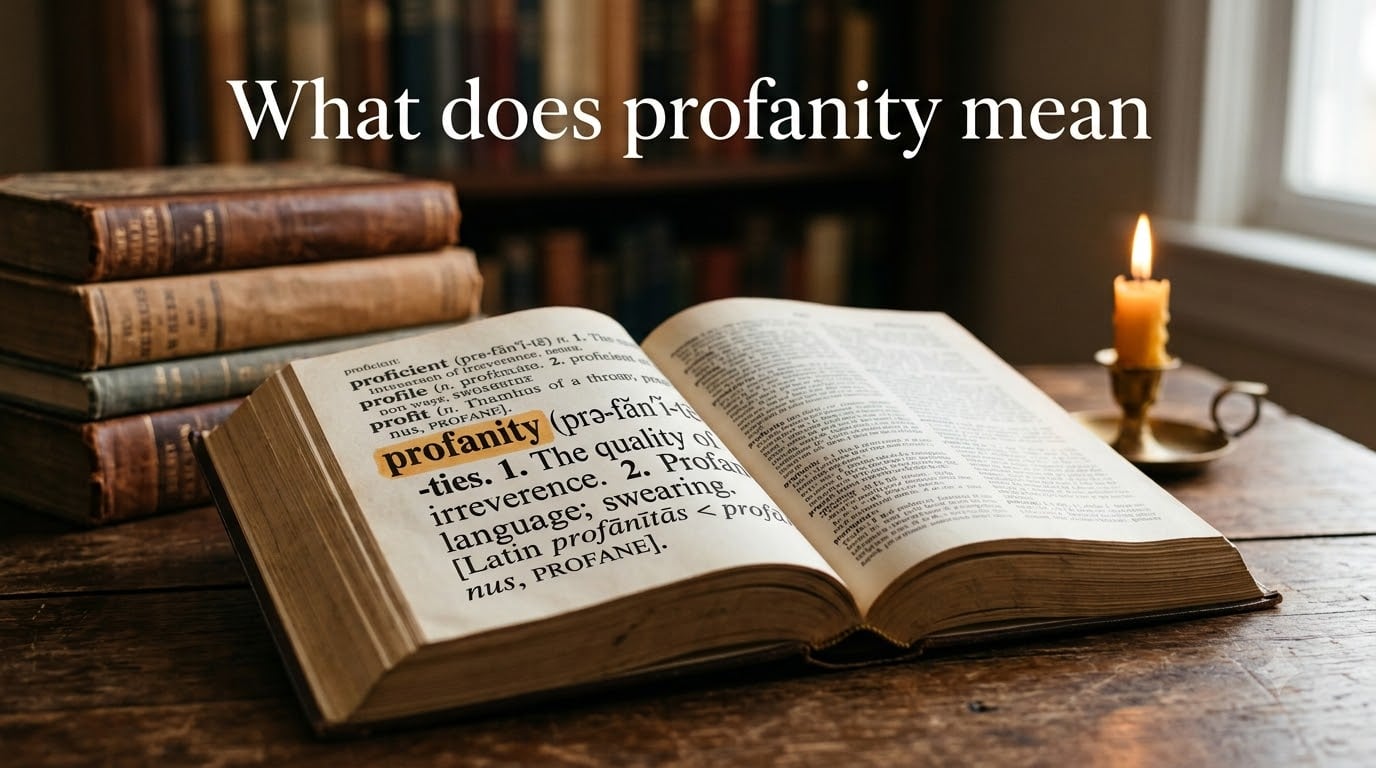
The profanity meaning centers on words and language that show a lack of respect for sacred things or that society considers offensive, vulgar, or taboo. When someone asks “what does profanity mean,” they usually want a clear definition plus a sense of which words count and why people use them.
In this guide, I break down the full definition, walk through the main types of profanity, explain the word’s Latin roots, and look at the psychology and culture behind swearing. By the end, you’ll have a complete picture of profanity meaning in English and how it plays out in everyday life.
Table of Contents
What Does Profanity Mean?
Profanity is language that is considered socially offensive because it is vulgar, obscene, or irreverent. The word refers both to the act of speaking that way and to the specific words themselves.
In a sentence, you might say “His speech was full of profanity” or “That word is considered profanity in most workplaces.” The Cambridge Dictionary defines profanity as “an offensive or obscene word or phrase,” while Merriam-Webster describes it as “the quality or state of being profane.”
Common examples include curse words, blasphemy, vulgar terms, and slurs. Phrases like “What the f***,” “damn it,” or religious exclamations used disrespectfully all count as profanity in many contexts.
Types of Profanity Explained
Not all offensive words fall into the same category. Here are the four main types of profanity that show up in English:
- Swear words: Strong expletives used to express emotion, frustration, or emphasis. Examples include “f***,” “s***,” and “b*******.” These are the most common form of profanity in casual speech.
- Blasphemy: Words that show disrespect toward religious figures, sacred objects, or beliefs. Examples include taking the Lord’s name in vain or using holy names as curses.
- Vulgarity: Crude or coarse language, often related to bodily functions or anatomy. Words tied to excretion or sex frequently fall into this group.
- Slurs: Derogatory terms targeting specific groups based on race, gender, sexuality, or other identity markers. These are widely considered the most harmful form of profanity.
Some words overlap between categories. A single word can be vulgar, profane, and act as a slur depending on context and who is using it.
Etymology and Word Origin
The word profanity traces back to the Latin “profanus,” meaning “outside the temple” or “not sacred.” It comes from “pro” (before, in front of) and “fanum” (temple). Something profane was originally anything that stood outside holy ground and was therefore unfit for sacred use.
By the late Middle English period, “profane” had shifted to mean anything irreverent or disrespectful, especially toward religious matters. The noun “profanity” appeared in English in the 1600s and broadened over time to include any language society finds offensive.
The adverb form is “profanely.” When someone asks about the meaning of the word profanely, the answer is simple: it means “in a profane manner” or “showing disrespect for sacred things.” For example, “He spoke profanely about the sermon.”
Why Do People Use Profanity?
People use profanity for at least five core reasons, and the reasons often overlap in a single conversation:
- Emotional expression: Swear words give people a fast way to release strong feelings like anger, joy, or surprise. When words like “wow” feel too weak, profanity fills the gap.
- Stress relief: Research shows that swearing can lower stress and help regulate emotions in tense moments. People often swear after stubbing a toe or receiving bad news.
- Social bonding: In casual groups, swearing signals trust and authenticity. Friends who swear around each other often signal closeness rather than hostility.
- Pain management: Studies from Keele University found that people who swear during pain can tolerate it longer. Swearing activates emotional brain regions that help reduce the feeling of pain.
- Emphasis: Profanity sharpens a sentence. A phrase like “that’s a great idea” hits harder when the adverb is a strong word.
The reasons matter for understanding the profanity meaning because the same word can be cathartic, bonding, or hurtful depending on why it’s used.
Synonyms and Related Terms
Profanity overlaps with several other terms but is not identical to them. Here’s how common synonyms differ:
- Swearing: The most common synonym for profanity, focused on the act of using taboo words. “Swearing” can also mean taking an oath, so context matters.
- Cursing: Often used to mean swearing, though it originally referred to calling down harm on someone. Today the two words are nearly interchangeable.
- Obscenity: A legal and social term referring to language that is deeply offensive, often with sexual content. Obscenity is a narrower category than profanity.
- Vulgarity: Coarse or crude language, especially around bodily functions. Vulgarity overlaps with profanity but focuses more on style than on social taboo.
- Blasphemy: A subset of profanity dealing specifically with irreverence toward religion or sacred things.
- Expletives: Words or phrases used to fill space or express emotion, often (but not always) profane. “Darn” and “f***” can both serve as expletives.
Knowing these distinctions helps when you need to describe a specific kind of offensive language rather than just profanity in general.
The Neurological and Psychological Effects of Swearing
One of the most interesting parts of the profanity meaning is what happens in the brain when people swear. Studies from researchers like Richard Stephens at Keele University show that swearing increases heart rate and skin conductance, but it also raises pain tolerance.
In one well-known experiment, people who repeated a swear word held their hand in ice water longer than people who repeated a neutral word. The swearing group rated the pain as less intense, suggesting that profanity serves a real emotional function.
Psychologically, swearing can produce a cathartic release. People who keep emotions bottled up sometimes find that a single strong word lets pressure out. At the same time, frequent swearing can desensitize both the speaker and listeners, reducing the emotional punch over time.
Swearing is also linked to honesty. A 2017 study published in Frontiers in Psychology found that people who used more profanity in conversation were more likely to be rated as authentic and trustworthy in their speech. This finding challenges the old idea that swearing always signals a weak vocabulary.
Cultural and Social Perspectives on Profanity
Profanity is not universal. What counts as profanity in English may not match the strongest taboo words in another language. In Japanese, for example, certain words about family members carry more weight than most English obscenities. In Arabic and many South Asian languages, curses targeting family honor can be far more offensive than swearing about bodily functions.
Within English, social context shapes how profanity lands. A word that is mild in a bar may be deeply offensive in a classroom, a funeral, or a workplace. Age, region, and subculture all play a role.
Minced oaths are a fascinating example of cultural adaptation. These are softened versions of taboo words, like “gosh” for “God,” “fudge” for a stronger expletive, or “shoot” for “s***.” People use minced oaths to express strong feelings without violating social norms. The practice goes back centuries and shows how cultures negotiate around profanity rather than just banning it.
Is Profanity a Crime?
Profanity is generally not a crime in most Western countries, including the United States. The First Amendment protects a wide range of speech, including offensive language, in public settings.
That said, there are limits. Profanity can be restricted in certain contexts, such as broadcast television and radio (where the FCC regulates indecent language), in schools, in workplaces with legitimate policies, and in courtrooms. Some states have specific laws against harassing speech aimed at individuals, and slurs used as threats can fall under hate speech statutes.
In short, ordinary profanity is legal speech. The exception is when profanity crosses into threats, harassment, or false advertising, where other laws apply.
Conclusion
The profanity meaning goes beyond a simple dictionary entry. It covers any language that disrespects the sacred, offends social norms, or hits where a culture is most sensitive. The word traces back to Latin roots meaning “outside the temple,” and modern usage now includes swear words, blasphemy, vulgarity, and slurs.
People use profanity for emotional expression, pain relief, social bonding, and emphasis, and the brain responds to swearing in measurable ways. Cultural context shapes which words carry the most weight, and laws treat most profanity as protected speech with narrow exceptions.
Understanding the profanity meaning in 2026 helps writers, students, parents, and educators handle offensive language with more nuance. Whether you’re choosing the right word for a story, setting guidelines for a workplace, or just curious about why a particular word feels so strong, the framework above gives you a clear answer.
Frequently Asked Questions
Is a bad word a profanity?
Yes, a bad word is generally a form of profanity when it is offensive, vulgar, or disrespectful. The terms overlap heavily, though profanity is a broader category that also includes blasphemy and slurs, not just everyday bad words.
Is profanity a bad thing?
Profanity is not inherently bad. It is a tool for emotional expression, stress relief, and emphasis. It can become harmful when it is used to insult, demean, or harass others, or when it shows up in contexts where it is not appropriate, such as professional settings.
Is profanity a crime?
In most cases, profanity is not a crime. The First Amendment in the United States protects offensive speech. Profanity can be restricted in certain places like schools, courtrooms, and broadcast media, and it can become illegal when it crosses into threats, harassment, or hate speech.
What is the meaning of the word profanely?
Profanely is the adverb form of profane. It means doing something in a way that shows disrespect for sacred things or that uses offensive language. For example, speaking profanely during a sermon would mean using irreverent or vulgar words.
Does profanity mean curse words?
Profanity includes curse words, but the meaning is broader. Curse words are a common type of profanity, along with blasphemy, vulgarity, and slurs. Not all profanity is a curse word, and not all curse words are considered equally offensive in every context.