
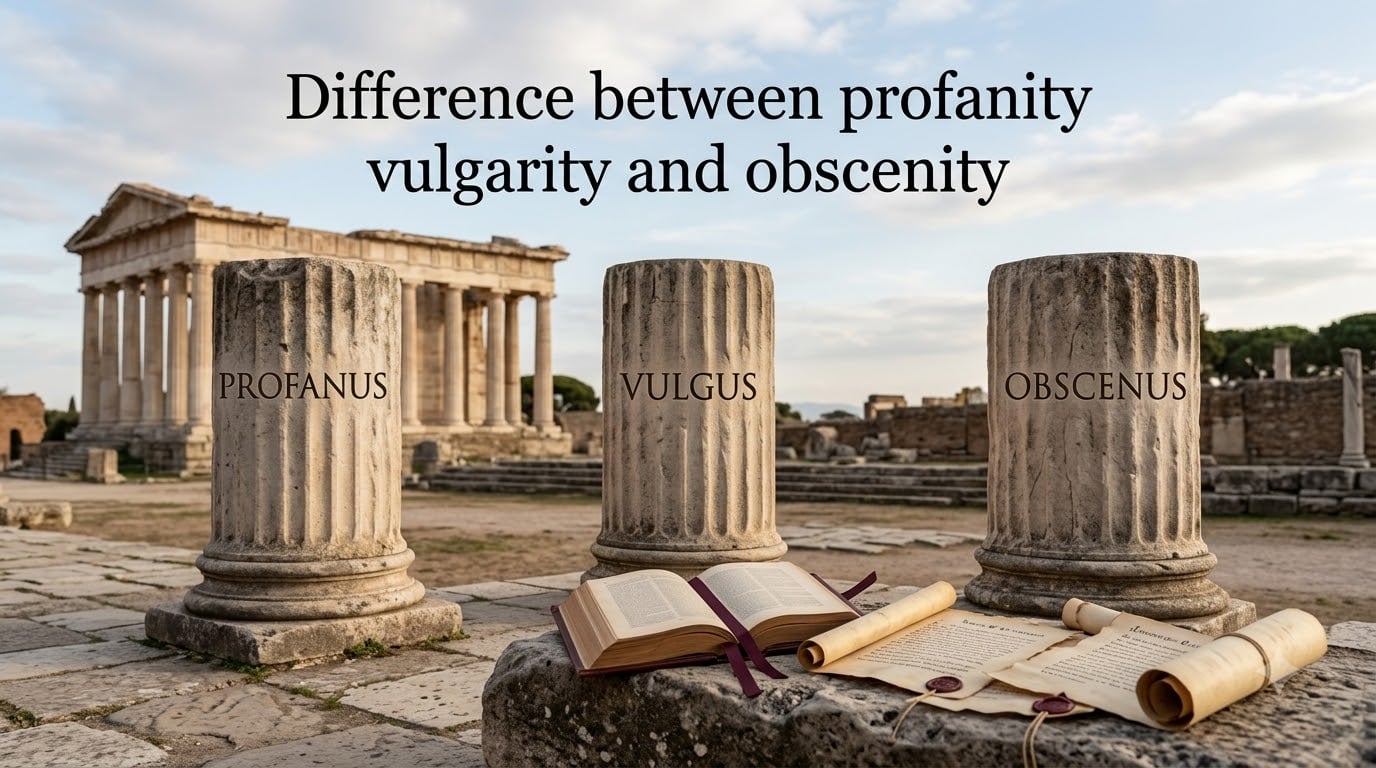
Most people use the words profanity, vulgarity, and obscenity interchangeably. I used to do the same thing until I dug into the history and realized these three terms describe completely different things. The difference between profanity vulgarity and obscenity comes down to what each one disrespects: religion, refined taste, or sexual morality.
Understanding these distinctions matters more than you might think. Writers need the right term for literary analysis. Legal professionals deal with obscenity laws that carry real consequences. Content creators navigate platform rules that treat each category differently. And anyone who communicates in professional or social settings benefits from knowing exactly which line they are crossing.
I spent time researching the Latin roots, legal frameworks, and linguistic history behind each term. What I found is that the confusion is understandable, because all three fall under the umbrella of taboo language or foul language. But once you learn the etymology and see clear examples, the boundaries become obvious.
Table of Contents
Quick Reference: Profanity vs Vulgarity vs Obscenity
Here is the short answer for anyone who needs it fast. These three terms each target a different domain of offense:
Profanity disrespects what is sacred or religious (from Latin profanus, meaning “outside the temple”). Example: using a religious oath as a swear word.
Vulgarity involves coarse, crude, or unrefined language (from Latin vulgus, meaning “the common people”). Example: four-letter words for bodily functions.
Obscenity offends sexual morality and can carry legal consequences (from Latin obscenus, meaning “repulsive”). Example: sexually explicit material deemed legally obscene.
The key distinction in one sentence: profanity offends the sacred, vulgarity offends taste, and obscenity offends sexual decency standards.
What Is Profanity?
Profanity comes from the Latin word profanus, which literally translates to “before” or “outside the temple.” The pro prefix means “before” and fanum means “temple.” So something profane existed outside the sacred space. Over centuries, the word shifted from describing things that were merely non-religious to things that actively disrespected religion.
In its strictest sense, profanity means treating sacred things with contempt or irreverence. This includes blasphemy, which specifically involves insulting or showing disrespect toward God or religious beliefs. When someone takes a religious oath in vain or uses sacred terms as casual expletives, that is profanity in its original sense.
Common examples include using divine names as curse words, making light of religious sacraments, or treating holy objects with deliberate disrespect. Many words we now think of generically as “swearing” started as literal profanity, invoking deities or religious concepts in inappropriate contexts.
It is worth noting that in modern everyday usage, the word profanity has expanded. Many dictionaries now define it broadly as irreverent or abusive language in general. But the linguistic and historical core of profanity remains tied to disrespecting the sacred.
What Is Vulgarity?
Vulgarity traces back to the Latin word vulgus, meaning “the common people” or “the crowd.” The related adjective vulgaris meant “common” or “ordinary.” Originally, vulgar simply described something belonging to everyday people rather than the educated elite. There was no inherent insult in calling language vulgar; it just meant common speech.
Over time, the meaning narrowed and gained a negative connotation. Vulgarity came to describe language or behavior that lacked refinement, polish, or good taste. It became associated with the stereotype that uneducated people spoke more crudely. This class-based origin is baked into the word itself.
Examples of vulgarity include crude references to bodily functions, scatological humor, and coarse slang that would be unwelcome in polite company. These expressions do not necessarily attack religion (that would be profanity) or deal in sexually explicit content (that would be obscenity). They are simply rough, indelicate, or socially unrefined.
Forum discussions I reviewed reveal that people often describe vulgarity as “coarse language” or “dirty words.” Reddit users in communities like r/linguistics and r/explainlikeimfive consistently categorize vulgarity as the mildest of the three categories, because it offends social taste rather than sacred values or legal standards.
What Is Obscenity?
Obscenity derives from the Latin obscenus, which meant “repulsive,” “filthy,” or “foul.” Unlike profanity and vulgarity, obscenity is the only category with significant legal weight. Obscene material or language deeply offends sexual morality and, in many jurisdictions, can be restricted or criminalized.
The challenge with obscenity is that it is notoriously hard to define objectively. Justice Potter Stewart famously wrote about obscenity in a 1964 Supreme Court case: “I know it when I see it.” That uncertainty has shaped decades of legal debate about what qualifies as obscene versus merely offensive.
In United States law, the Supreme Court established the Miller test in the 1973 case Miller v. California. Under this three-part standard, material is legally obscene if the average person applying community standards would find it appeals to the prurient interest, it depicts sexual conduct in a patently offensive way, and it lacks serious literary, artistic, political, or scientific value. All three conditions must be met.
This legal framework is critical because obscenity is the one category of speech that does not receive full First Amendment protection. Profanity and vulgarity, while socially discouraged, are generally constitutionally protected. Obscenity can be banned, regulated, or prosecuted depending on jurisdiction.
The FCC also regulates broadcast content involving obscenity and indecency. Federal law prohibits obscene material on broadcast television and radio at all times, while indecent material (which falls short of full obscenity) is restricted to late-night hours when children are unlikely to be in the audience.
Key Differences Between Profanity, Vulgarity, and Obscenity
The clearest way to understand the difference between profanity vulgarity and obscenity is to compare them side by side across several dimensions. Each term has a distinct origin, target, and social consequence.
Target of offense: Profanity disrespects religion and the sacred. Vulgarity violates standards of refined taste and social decorum. Obscenity offends sexual morality and community standards of decency.
Etymology: Profanity comes from Latin profanus (“outside the temple”). Vulgarity comes from Latin vulgus (“the common people”). Obscenity comes from Latin obscenus (“repulsive”).
Legal status: Profanity is generally protected by the First Amendment. Vulgarity is also constitutionally protected in most contexts. Obscenity is the only category that can be legally banned or prosecuted in the United States.
Typical examples: Profanity includes using religious names as swear words. Vulgarity includes crude slang for bodily functions. Obscenity includes sexually explicit material that fails the Miller test.
Social severity: Obscenity is typically considered the most serious, followed by profanity in religiously observant contexts, with vulgarity often viewed as the mildest offense against social norms.
One important point that forum users frequently raise is that context changes everything. A word that functions as vulgarity in one setting could carry profane weight in a religiously charged context. The categories overlap in practice, even though their definitions are distinct.
Legal Distinctions: What the Law Says
The legal landscape around offensive language centers on the First Amendment in the United States. Understanding the legal angle helps separate these terms in practical terms, not just academic ones.
The Supreme Court has consistently held that profanity and vulgarity are protected speech. In Cohen v. California (1971), the Court ruled that a jacket bearing an offensive expletive was protected expression. The government cannot broadly ban words merely because they are vulgar or profane.
Obscenity is different. It is the one category of speech that falls outside First Amendment protection. This means federal and state governments can pass laws restricting obscene material, and prosecutors can bring charges for distributing it. The Miller test remains the governing standard for determining whether content crosses into legally obscene territory.
Broadcast media face additional rules through FCC regulations. The FCC can fine stations for airing obscene content at any time and indecent content between 6 a.m. and 10 p.m. These rules do not apply to cable, satellite, or the internet in the same way, which is why broadcast standards feel stricter.
The Psychology Behind Why People Swear
One area almost no competitor covers is why we swear at all. Research into the psychology of swearing reveals fascinating insights about how the brain processes taboo language.
Studies by psychologist Timothy Jay and others have shown that swearing serves real functions. People curse to express strong emotion, relieve stress, signal group identity, and even tolerate pain. One well-known study found that participants who repeated swear words could hold their hands in ice water longer than those who repeated neutral words, suggesting that cursing has a genuine pain-buffering effect.
Swearing activates different brain regions than regular speech. While most language processing happens in the left hemisphere, taboo words also trigger the limbic system and amygdala, which handle emotion. This is why people with severe aphasia who lose most language ability can sometimes still swear fluently, because those words are stored and processed differently.
Not all swearing falls into the same category. Someone might use profanity out of anger, vulgarity for humor, or obscenity for shock value. The motivation behind the language often reveals which category is in play.
How These Words Evolved Over Time
The meaning of offensive language is not fixed. Words shift between categories of profanity, vulgarity, and obscenity as cultures change. Understanding this evolution helps explain why the lines between the three terms feel blurry today.
In medieval Europe, the most powerful taboo words were religious. Blasphemy was a serious crime, and profaning holy names carried genuine legal and social consequences. Sexual and scatological words existed but were considered merely vulgar, not legally dangerous.
The balance shifted dramatically in the Victorian era. Nineteenth-century society developed intense sensitivities around sexual and bodily topics. Words that once qualified as simple vulgarity gained much heavier social weight. At the same time, religious profanity began losing its sting as secularism increased and blasphemy stopped being a punishable offense in most Western countries.
Today, the hierarchy continues to shift. Many religious oaths that once counted as serious profanity are now so common they barely register as offensive. Meanwhile, certain vulgar terms carry more social consequences than ever due to heightened awareness of how language affects different groups. Obscenity law remains active but has narrowed significantly compared to past decades.
This historical drift is why the three categories overlap in practice. A word might have started as religious profanity, drifted into general vulgarity, and now function in contexts that some would call obscene. The original etymology still defines the boundaries, even as everyday usage blurs them.
FAQs
Is vulgarity and profanity the same thing?
No, they are not the same. Profanity specifically disrespects sacred or religious things, from the Latin profanus meaning outside the temple. Vulgarity refers to coarse or unrefined language, from the Latin vulgus meaning the common people. The key difference is that profanity targets religion while vulgarity targets social taste.
What is the difference between obscenity and vulgarity?
Vulgarity is crude or unrefined language that offends social taste but is generally protected speech. Obscenity is material that deeply offends sexual morality and can be legally restricted or banned. Vulgarity comes from Latin vulgus meaning common people, while obscenity comes from Latin obscenus meaning repulsive. Obscenity carries potential legal consequences that vulgarity does not.
What is the difference between an obscenity and a profanity?
Profanity disrespects religion or sacred things, from Latin profanus meaning outside the temple. Obscenity offends sexual morality and can be legally prosecuted under the Miller test standard. Profanity is protected by the First Amendment, while obscenity is the one category of speech that does not receive full constitutional protection in the United States.
What qualifies as obscenity?
In United States law, material qualifies as legally obscene if it meets all three parts of the Miller test established in 1973: the average person applying community standards would find it appeals to prurient sexual interest, it depicts sexual conduct in a patently offensive way, and it lacks serious literary, artistic, political, or scientific value. All three conditions must be met for material to be considered obscene.
Conclusion
The difference between profanity vulgarity and obscenity boils down to three targets: the sacred, refined taste, and sexual morality. Profanity comes from outside the temple and disrespects religion. Vulgarity comes from the common people and describes coarse, unrefined language. Obscenity is repulsive material that violates sexual decency and, uniquely among the three, can be restricted by law.
These distinctions have real consequences. Writers and educators need accurate terminology. Legal professionals navigate obscenity laws that carry criminal penalties. Content creators face platform policies that treat each category differently. And in everyday communication, knowing which type of offense a word commits helps you understand why it offends and how to respond.
Language keeps evolving, and the boundaries between these categories will keep shifting. But the etymological roots and legal frameworks give you a reliable foundation for telling them apart.