
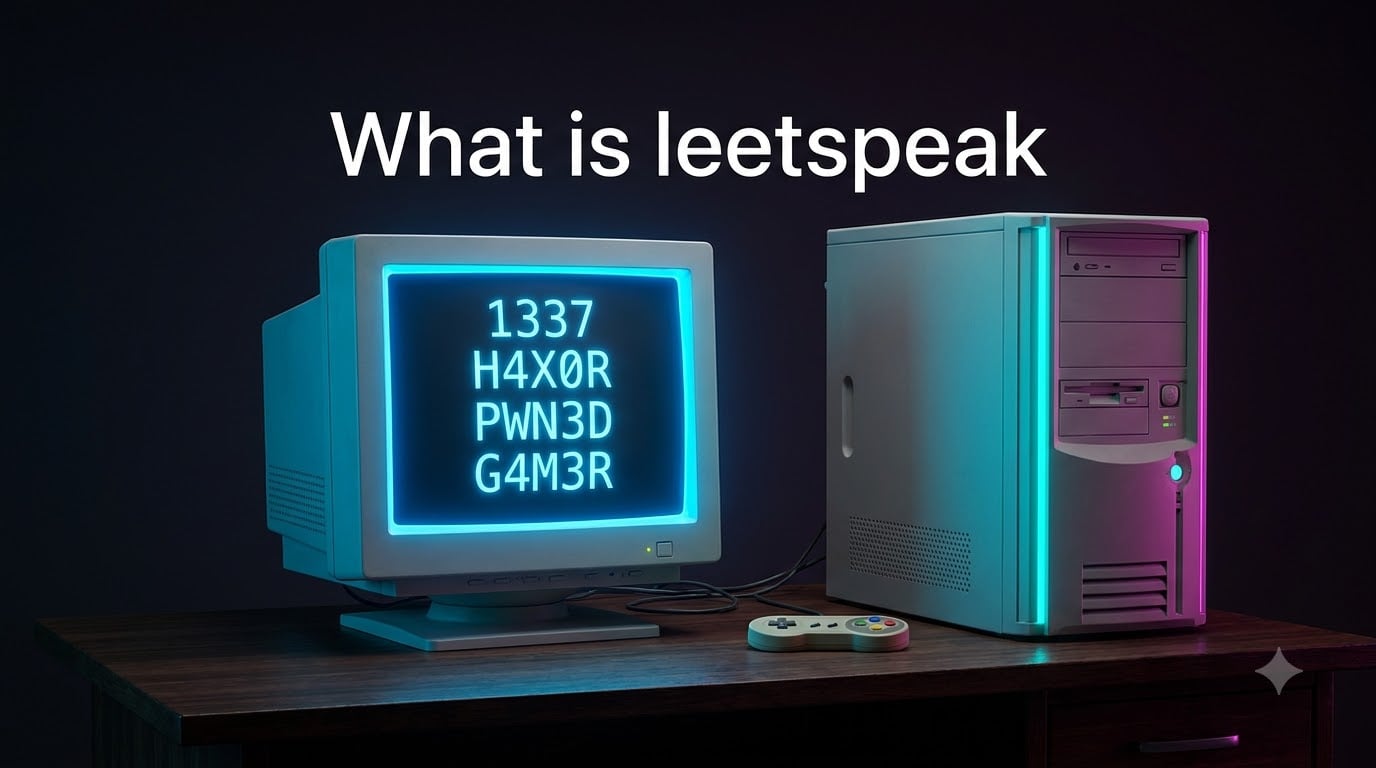
If you’ve ever seen a gamer tag like xX_H4x0r_Xx or stumbled across a forum post written as n00b 5p34k, you’ve already met leetspeak without knowing its name. This guide answers the core question: what is leetspeak, where it came from, how it works, and why it still shows up in online corners of the internet in 2026.
Leetspeak (also written as “leet speak” or “l33t speak”) is a coded form of written communication that swaps standard letters for numbers and symbols that look similar. It began on 1980s bulletin boards, spread through hacker and gaming circles in the 1990s, and remains a recognizable piece of internet culture today.
By the end of this article, you’ll know exactly what leetspeak means, how to read it, and why some online communities still use it.
Table of Contents
- What Is Leetspeak? A Clear Definition
- Where Did Leetspeak Come From?
- The Leet Alphabet: Common Letter Substitutions
- Different Forms of Leetspeak (1337, UCE, Ultra 1337)
- Examples of Leetspeak in Words and Phrases
- How to Read and Write Leetspeak
- Modern Usage: Who Uses Leetspeak Today?
- Drawbacks and Challenges of Leetspeak
- Frequently Asked Questions About Leetspeak
- Conclusion: Why Leetspeak Still Matters
What Is Leetspeak? A Clear Definition
Leetspeak is an alternative alphabet used on the internet in which standard letters are replaced with visually similar numbers, symbols, or character combinations. It is also called 1337 (because “leet” itself is written as “1337”) or simply leet.
The word “leet” comes from the English word “elite.” In early internet culture, “leet” was shorthand for being elite or skilled at hacking, programming, or gaming. To prove you were elite, you would write in this special alphabet. Over time, the alphabet itself became known as leetspeak.
Here’s a simple example: the word “leet” becomes “1337” (L=1, E=3, E=3, T=7). The word “hacker” becomes “h4x0r” (a=4, c=x, k stays, e=0, r stays). The word “elite” itself becomes “3l33t” or “31337.”
At its core, leetspeak is a substitution cipher that uses the visual similarity between numbers and letters to encode messages.
Where Did Leetspeak Come From?
Leetspeak originated in the 1980s on early online communities called Bulletin Board Systems (BBS). Users dialed into these systems with modems to share files, chat, and play text-based games.
System administrators and senior users wanted ways to identify trusted members and keep out outsiders, including people who tried to bypass the basic word filters used to block profanity or banned topics. Leetspeak solved two problems at once: it created an in-group language that signaled technical skill, and it allowed users to slip past simple text filters that looked for specific blocked words.
By the late 1980s and early 1990s, the practice spread to Usenet newsgroups and the early web. According to Wikipedia and several cybersecurity glossaries, the earliest documented use of “leet” as a term of status dates back to the 1980s, with the spelling “l33t” appearing in hacker circles by the mid-1990s.
The culture around leetspeak also overlapped with cyberpunk fiction, ASCII art, and early hacker ethics. Movies like Hackers (1995) and games like Doom and Quake helped push the look into mainstream awareness, even if most casual internet users never adopted it themselves.
The Leet Alphabet: Common Letter Substitutions
The most useful thing to memorize if you want to read leetspeak is the leet alphabet. Below is the most common set of substitutions used in everyday leetspeak writing.
Most common single substitutions:
- A = 4 (sometimes @)
- B = 8 (sometimes 6)
- C = ( or <
- D = |) or 0 (with a slash)
- E = 3
- F = ph or |=
- G = 6 or 9
- H = # or |-|
- I = 1 or ! or |
- L = 1 or | or !
- N = | | or n
- O = 0 (zero)
- R = 2 or |2
- S = 5 or $
- T = 7 or +
- U = |_| or ()
- Z = 2 or s
Quick example words:
- elite = 3l33t or 31337
- hacker = h4x0r or h4xx0r
- noob = n00b
- leet = 1337
- speak = sp34k
- cool = k00l or (00l
Notice how the numbers lean heavily on the digits 0, 1, 3, 4, 5, and 7. Those six digits cover the most common letter swaps, which is why “1337” became the iconic spelling of the word “leet.”
Writers often mix uppercase and lowercase, drop vowels entirely, or chain substitutions together. The more substitutions you chain, the harder the word is to read, and the more “elite” the writer appears.
Different Forms of Leetspeak (1337, UCE, Ultra 1337)
Leetspeak isn’t a single fixed system. Over the years, three main levels of complexity developed, sometimes called l33t, UCE, and Ultra 1337.
1. l33t (basic leetspeak) uses only the simplest substitutions. Anyone can read it with a few seconds of effort. Examples include “leet” as “1337” or “noob” as “n00b.” This is the form most people actually encounter today.
2. UCE (Untranslatable Character Encode) is more advanced. It uses unusual Unicode characters, accented letters, and symbols that don’t always map cleanly back to standard English. The intent is purely to look impressive or unreadable, not to communicate clearly.
3. Ultra 1337 pushes substitutions to the extreme, replacing almost every letter with a symbol and stacking multiple variants together. Sentences become nearly unreadable to outsiders. This form is rare today and mostly survives as a joke or in old archives.
For practical purposes in 2026, almost everyone uses basic l33t. The other two levels are mostly historical curiosities.
Examples of Leetspeak in Words and Phrases
Seeing leetspeak in action is the fastest way to learn it. Here are common phrases you’ll still see in gaming chats, forums, and old-school memes.
- Hello = h3ll0 or h3110
- Player = p14y3r or pl4y3r
- Thanks = th4nx or +h4nks
- You = j00 or y00
- Are = r or |2
- What = wh4t or ||/h4+
- Skill = sk1ll or $k!ll
- Pwned = pwn3d (a slang word meaning “owned” or “defeated”)
- Own3d = 0wn3d or 0wn4g3
The phrase “all your base are belong to us”, an iconic 1989 video game translation error, has been re-encoded into leet as “411 y0ur b4s3 4r3 b310ng t0 u5.” It’s a fun piece of internet history that shows how leetspeak is applied to longer sentences.
How to Read and Write Leetspeak
If you’ve never tried reading leetspeak before, the trick is to look for shape, not spelling. Letters in leet are chosen because they look like the original letter, even when they’re not. Start with these steps:
- Learn the six core digits. Memorize that 0=o, 1=i or l, 3=e, 4=a, 5=s, and 7=t. That covers roughly 80% of what you’ll see.
- Recognize the dollar sign for S. “$” almost always means “s,” as in “$k1ll” (skill) or “$p34k” (speak).
- Read the surrounding letters. If the rest of a word looks familiar, just slot in the swapped letters mentally. “h4ck3r” with the swaps becomes “hacker.”
- Drop the vowels only if needed. Some leet writers remove vowels entirely (“hckr” for “hacker”) for an extra layer of obfuscation.
- Practice on usernames and clan tags. Old gaming forums and clan rosters are full of readable leet text you can decode.
Writing leetspeak is even easier: pick the words you want to encode, swap the obvious letters for numbers, and stop when it looks right. Most writers don’t go further than two or three swaps per word.
Modern Usage: Who Uses Leetspeak Today?
So, is leetspeak still used? Yes, but in a much smaller way than at its peak. Modern leetspeak shows up in a few specific places.
Gaming communities are the biggest remaining home of leetspeak. Gamers use it in usernames, clan tags, and inside-joke chat messages. Game titles like Counter-Strike, Call of Duty, and World of Warcraft have all featured leetspeak-style names.
Cybersecurity and hacker culture still reference leetspeak as part of their shared history. Terms like “leet hacker” or “1337 h4x0r” appear in CTF (Capture The Flag) competitions and security conferences, often as tongue-in-cheek self-reference.
Usernames and gamertags across platforms like Xbox Live, PlayStation Network, Steam, and Discord continue to use leetspeak because it helps create unique handles that aren’t already taken.
Memes and nostalgia keep leetspeak alive among users who grew up in the 1990s and early 2000s. Forum users on Reddit have noted that leetspeak “almost disappeared by 2005,” but the style resurfaces whenever 90s internet culture gets revived.
Outside these niches, leetspeak is rarely used in everyday texting or social media. Modern slang has largely moved on to acronyms like “lol,” “tbh,” and “fr.”
Drawbacks and Challenges of Leetspeak
Even if leetspeak is fun to decode, it has real downsides that explain why it never went fully mainstream.
- Hard to read. Heavy leetspeak slows comprehension, especially for beginners or anyone unfamiliar with the substitutions.
- Accessibility issues. Screen readers and translation tools often can’t parse heavily leeted text, which makes it a barrier for users with disabilities.
- Looks like spam. Many platforms, search engines, and email filters flag heavily substituted words as suspicious or spammy, which is ironic given that leetspeak was originally created to bypass filters.
- Outdated feel. Younger internet users often see leetspeak as a relic of 90s internet culture and prefer modern abbreviations instead.
- Can confuse non-native English speakers. Combining slang, dropped vowels, and substitutions makes leet almost impossible to decode for someone still learning English.
These drawbacks are part of why leetspeak stayed a niche language instead of becoming a true alternative writing system.
Frequently Asked Questions About Leetspeak
What does 1337 mean for gamers?
In gaming culture, 1337 (pronounced u0022leetu0022) means elite, skilled, or top-tier. A u00221337 playeru0022 is someone exceptionally good at a game, and using 1337 in a username or message signals that you belong to the gaming insider community. The spelling comes from the leetspeak alphabet where L=1, E=3, E=3, T=7.
Is leetspeak still used today?
Yes, but mainly in gaming usernames, clan tags, hacker culture references, and nostalgic 90s internet content. Most everyday online communication has moved to modern abbreviations like u0022lolu0022 or u0022tbhu0022 instead of leetspeak. You will still see it on platforms like Discord, Steam, and gaming forums in 2026.
What are the drawbacks of using leetspeak?
The main drawbacks are readability, accessibility, and spam filtering. Heavy leetspeak is hard to read for beginners, breaks screen readers and translation tools, and often gets flagged by search engines and email filters. It can also feel dated to younger users who prefer modern slang.
Who uses leetspeak?
Leetspeak is primarily used by gamers, cybersecurity enthusiasts, retro internet culture fans, and people creating unique usernames. It is rare in professional or casual everyday texting, but it remains part of hacker and CTF (Capture The Flag) competition culture as a nod to early internet history.
Why was leetspeak originally created?
Leetspeak was created in the 1980s on bulletin board systems to help users bypass basic word filters and to signal elite technical status. By swapping banned words with numbers and symbols, users could communicate without triggering the simple text filters of the time, while also showing they were part of the trusted in-group.
How do you write in leetspeak?
To write in leetspeak, replace letters with visually similar numbers or symbols using the leet alphabet: A=4, E=3, I=1, O=0, S=5 or $, T=7. For example, u0022eliteu0022 becomes u00223l33tu0022 and u0022hackeru0022 becomes u0022h4x0r.u0022 Start with the basic substitutions and only add more if your audience can read them.
Conclusion: Why Leetspeak Still Matters
So, what is leetspeak? It’s a coded internet alphabet built on letter-to-number swaps, born from 1980s bulletin board culture, and still alive in gaming and hacker communities in 2026.
Even though modern slang has moved past it, leetspeak remains a useful lens into how online communities build their own language, signal belonging, and shape the way we communicate online. If you’re curious about internet history or just want to decode the next gamertag you see, learning the basic leet alphabet is a fun and surprisingly quick way to unlock a whole layer of online culture.