
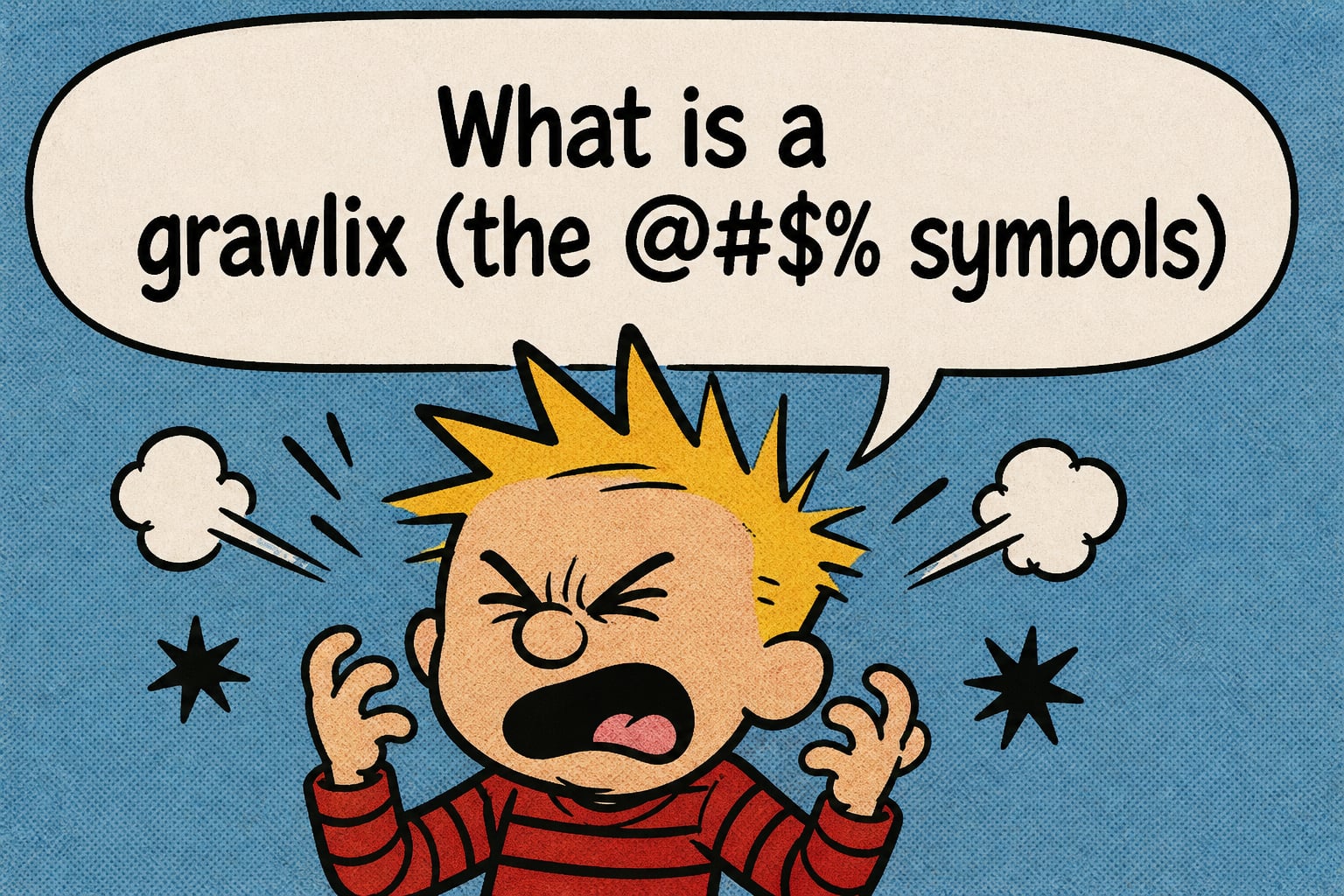
If you’ve ever looked at a comic strip and seen a string of symbols like @#$%&! floating in a speech bubble, you’ve spotted a grawlix. A grawlix is the cluster of typographical symbols that cartoonists and comic artists use to stand in for swear words that can’t appear in print. Pronounced /grawlix/ (it rhymes with “stick”), the term gives a formal name to what is also called an obscenicon, symbol swearing, or a comic curse.
I first learned the word while rereading old The Katzenjammer Kids strips in college, and I still grin every time I see a fresh string of $#@!% in a Sunday paper. This guide covers the definition, who coined the term, the surprising history behind these symbols, the common characters used, and how grawlixes differ from asterisks and minced oaths.
Table of Contents
- What Is a Grawlix? Definition and Pronunciation
- Who Coined the Term Grawlix?
- History of the Grawlix in Comics
- Common Grawlix Symbols and What They Mean
- Grawlix vs Asterisk Redaction vs Minced Oaths
- Modern Usage and Social Media Examples
- Frequently Asked Questions About Grawlix
- Conclusion: Why Grawlix Matters in Comics
What Is a Grawlix? Definition and Pronunciation
A grawlix is a string of typographical symbols used in place of profanity, almost always appearing inside a speech balloon in a cartoon or comic strip. The word is pronounced /grawlix/ (rhymes with “stick”), and it is sometimes spelled grawlex or pluralized as grawlixes.
Merriam-Webster added “grawlix” to its dictionary in 2018, defining it as “a string of typographical symbols used to indicate profanity.” The Oxford English Dictionary followed in 2025. Both dictionaries treat grawlix as a noun, with Merriam-Webster dating its earliest known use to 1964.
You will also see the same concept called an obscenicon, a term favored by linguists and dictionary editors who like a more formal-sounding word. Symbol swearing is the broader descriptive phrase, while grawlix is the catchier label that comic fans actually use.
Who Coined the Term Grawlix?
The term grawlix was coined by American cartoonist Mort Walker, the creator of Beetle Bailey and Hi and Lois. Walker invented the word in a 1964 article for The Comics Journal, where he was discussing the visual language of comic strips.
Walker later expanded on the idea in his 1980 book The Lexicon of Comicana, a humorous treatise on the symbols and conventions of cartooning. In it, he coined several playful terms for things like dust clouds over a knocked-out character (briffit), the lines that show speed or movement (hites), and the asterisks used to indicate a curse word (grawlix).
Although Walker’s coining came decades after grawlixes themselves appeared in print, his catchy name stuck. It gave comic fans, editors, and eventually dictionaries a single word to describe what was previously just “those @#$%&! symbols.”
History of the Grawlix in Comics
The grawlix is older than the word for it. The earliest known printed use of typographical symbols standing in for profanity appears in a 1901 cartoon called “The Coarse Hack” by cartoonist Gene Carr, published in a Hearst newspaper. In the cartoon, a horse pulls a carriage whose driver shouts “@#$%” at the horse.
The technique really took off in 1902 in The Katzenjammer Kids by Rudolph Dirks. The mischievous twin protagonists regularly cursed in their speech balloons, and editors refused to print the actual words. Dirks solved the problem by filling the balloons with strings of @, #, $, %, !, and & characters. The strip became hugely influential, and other cartoonists copied the trick.
Throughout the 20th century, grawlixes became standard in newspaper strips and comic books. The 1954 establishment of the Comics Code Authority in the United States, which banned certain words and imagery from comics, pushed artists to lean even harder on symbol swearing to keep their edge without violating the code.
By the time Mort Walker named the grawlix in 1964, the symbol had been a comic-staple for more than 60 years. Today, grawlixes appear in everything from newspaper strips like Zits and Doonesbury to graphic novels and webcomics.
Common Grawlix Symbols and What They Mean
Most grawlixes are drawn from the characters above the number row on a standard QWERTY keyboard. The classic lineup is:
- @ — the most common “letter substitute” because it vaguely looks like a lowercase a
- # — often stands in for h or s because of its shape
- $ — represents S visually
- % — a generic curse-character, sometimes a stand-in for o
- & — the ampersand, used because it looks like a stylized et or just looks angry
- ! — the exclamation point, often doubled or tripled for emphasis
- * — the asterisk, the original censoring character
Not every symbol in a grawlix is “unpronounceable” in the strict linguistic sense. The string @#$%&! is actually a clever visual pun: readers can often map the symbols back to the original letters. That’s part of why grawlixes feel so satisfying. You get the catharsis of reading a curse word without anyone actually printing one.
Researchers have noted a small psychological effect here. The brain processes the grawlix as profanity even though the letters are technically gibberish, which is exactly the trick cartoonists want.
Grawlix vs Asterisk Redaction vs Minced Oaths
Grawlixes are sometimes confused with two related forms of curse-word replacement: asterisk redaction and minced oaths. They are not the same thing.
- Grawlix uses a string of mixed symbols (like @#$%&!) to evoke swearing. The whole point is not to be readable as a real word.
- Asterisk redaction uses repeated asterisks (like f***** or s***) where the first letter or two are preserved. The reader is meant to figure out the original word from context.
- Minced oaths are softened substitutes that sound like the real curse but use a polite word instead — “gosh darn,” “heck,” “zounds,” “fudge.”
Mort Walker actually had a separate term for asterisk redaction. He called it a profallix. Walker’s playful terminology shows just how carefully he thought about the visual vocabulary of comics. In practice, though, most people use “grawlix” as a catch-all for any symbol-based curse replacement.
Modern Usage and Social Media Examples
The grawlix has migrated well beyond newspaper comics. On social media, the Unicode consortium added a dedicated “face with symbols on mouth” emoji, U+1F92C, in 2018, which shows a cartoon face covering its mouth with the symbols @#$%&! floating around it. The emoji is the unofficial official acknowledgment that grawlixes are now part of the global visual vocabulary.
You’ll also see grawlixes in text messages, chat apps, and email signatures. They serve the same purpose they always have: letting the writer vent without committing an actual obscenity to the permanent record. A frustrated “well, @#$%&! this” carries emotional weight without triggering workplace filters.
In non-English comics, the tradition lives on in slightly different forms. Japanese manga uses symbols like くそっ or ちくしょう more often than ASCII characters, but the grawlix spirit is the same. European comics lean on garbled onomatopoeia rather than symbols, but the censorship instinct is shared.
Frequently Asked Questions About Grawlix
What are the swear word symbols in comics?
The swear word symbols used in comics are called a grawlix (also known as an obscenicon or symbol swearing). A grawlix is a string of typographical symbols such as @, #, $, %, u0026amp;, !, and * placed in a speech balloon to represent profanity that cannot be printed directly. The term was coined by cartoonist Mort Walker in 1964 and added to Merriam-Webster’s dictionary in 2018.
What are the symbols for expletives?
The most common symbols for expletives in cartoons and comics are the characters that sit above the number row on a QWERTY keyboard: @ # $ % u0026amp; ! and *. Cartoonists usually combine them in a string like @#$%u0026amp;! or $#@!%. The characters are chosen because they vaguely resemble English letters, are easy to type, and read as angry to the eye.
What is a grawlix slang?
In slang terms, a grawlix is simply the cluster of symbols like @#$%u0026amp;! that cartoonists draw in speech bubbles to represent swearing. It is not an insult itself, just the informal name for a visual shorthand that comic strips have used since the early 1900s. The word is now formal enough to appear in Merriam-Webster and the Oxford English Dictionary.
What is an example of a grawlix?
A typical grawlix looks like @#$%u0026amp;! or $#@!% floating inside a speech balloon in a comic strip. Real-world examples include the curses drawn in The Katzenjammer Kids starting in 1902 and in modern strips like Zits and Doonesbury. The 2018 Unicode emoji U+1F92C, which shows a face covering its mouth with @#$%u0026amp;! symbols, is also a grawlix.
When was the grawlix first used?
The grawlix as a visual device was first used in a 1901 cartoon called The Coarse Hack by Gene Carr. The technique became famous in 1902 in The Katzenjammer Kids by Rudolph Dirks. The word grawlix itself came much later, when cartoonist Mort Walker coined it in a 1964 article for The Comics Journal.
Conclusion: Why Grawlix Matters in Comics
So, what is a grawlix? It is a string of typographical symbols — usually @, #, $, %, &, !, and * — that stands in for profanity inside a comic-strip speech balloon. Pronounced /grawlix/, the term was coined by Mort Walker in 1964 and has since made its way into Merriam-Webster and the Oxford English Dictionary.
The grawlix matters because it solves a problem that comic artists have faced for more than a century. Editors often refuse to print actual curses, but readers still want their characters to feel real and reactive. A well-drawn @#$%&! does exactly that: it shows the anger, keeps the strip family-friendly, and adds a visual gag that plain text can’t match.
Next time you spot a grawlix in your morning paper, take a second to appreciate the craft. From Gene Carr’s 1901 The Coarse Hack to today’s webcomics and Unicode emoji, the grawlix has quietly become one of the most enduring visual conventions in the medium. For more on comic language and how to think about speech balloons, try sketching your own grawlix the next time you doodle.