
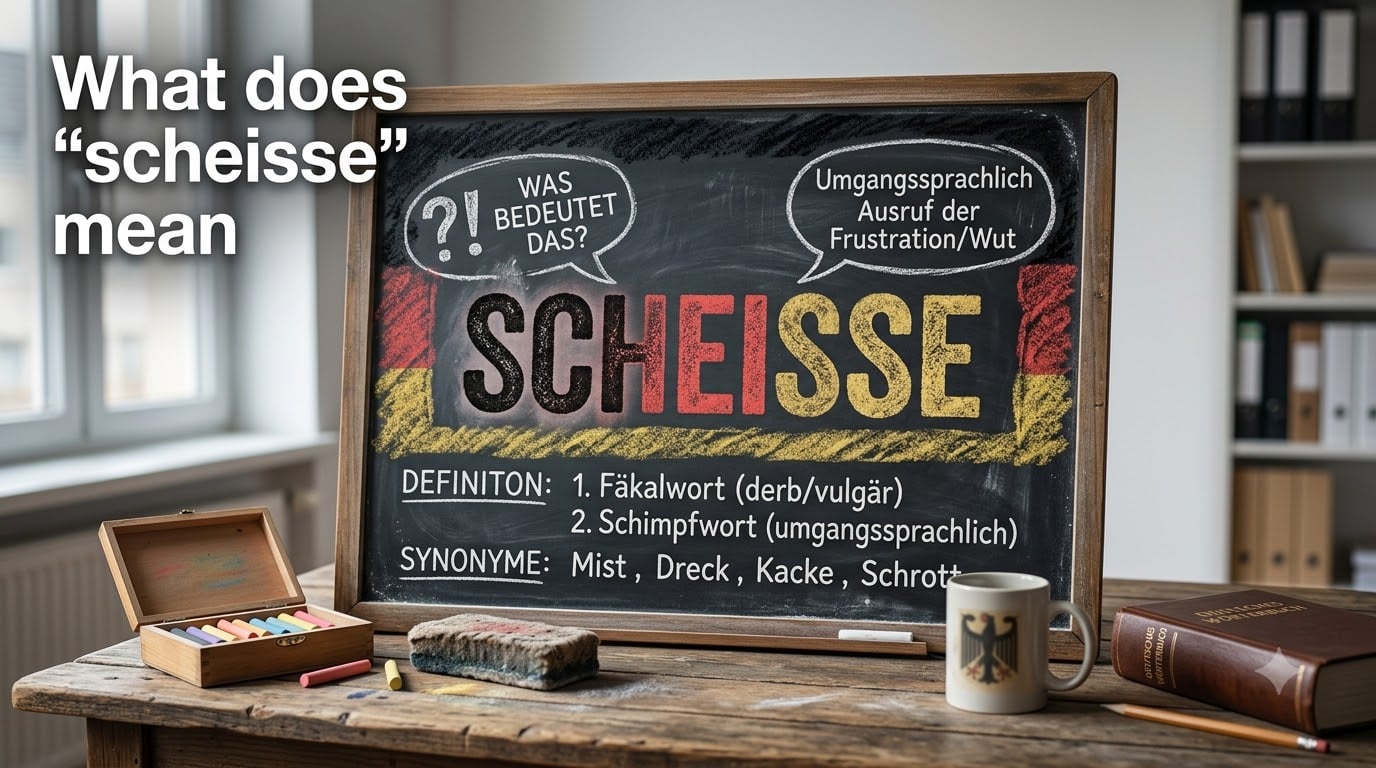
If you have ever watched a German movie, listened to a Rammstein song, or spent time with German-speaking friends, you have probably heard the word Scheiße. It is one of the most recognizable German words worldwide, right up there with “danke” and “gesundheit.” But what does scheisse mean, exactly? Is it as offensive as English speakers might assume?
The short answer is that Scheiße translates to “shit” or “crap” in English. But the full picture is much more nuanced. In this guide, our team breaks down everything you need to know about this ubiquitous German word, from its ancient roots to its role in modern pop culture.
We will cover the scheisse meaning, pronunciation, etymology, usage patterns, regional differences, and how it compares to other German swear words. Whether you are learning German, translating a text, or just curious about the language, this article gives you the complete picture.
Table of Contents
- What Does Scheisse Mean? Quick Definition
- How to Pronounce Scheisse
- Scheisse Etymology: Where the Word Comes From
- How Scheisse Is Used: Exclamation, Noun, and Prefix
- Common Scheisse Compound Words
- Regional Variations of Scheisse Across Germany
- Scheisse vs Other German Swear Words: A Severity Comparison
- Cultural Context: Is Scheisse Really a Bad Word?
- FAQs
- Conclusion
What Does Scheisse Mean? Quick Definition
Scheiße is a German vulgar noun and exclamation that literally translates to “shit” or “crap,” used to express frustration, disappointment, or to describe something as worthless. The scheisse meaning spans both literal (feces) and figurative (something bad) uses, making it one of the most versatile words in the German language.
Here is the quick breakdown of how the word functions:
As an exclamation: “Scheiße!” — equivalent to “Damn!” or “Shit!” in English, used when you stub your toe or make a mistake.
As a noun: “Das ist Scheiße” — “That is crap/bad,” describing something of poor quality or a bad situation.
As an intensifier prefix: “scheißkalt” — “damn cold” or “fucking cold,” amplifying an adjective.
Literal meaning: feces or excrement, though this literal use is rare in everyday speech.
The formal German equivalents for the literal meaning are Kot or Exkremente, which are the clinical terms you would find in medical or scientific contexts.
How to Pronounce Scheisse
The IPA pronunciation of Scheiße is /ˈʃaɪ̯sə/. For English speakers who are not familiar with phonetic notation, here is a simpler way to think about it.
Break it into two syllables: SHY-suh. The first syllable “shy” rhymes with the English word “shy,” and the second syllable “suh” sounds like the “uh” in “about.” The stress goes on the first syllable.
The key sound that trips up many learners is the ß character, called Eszett or scharfes S (sharp S). It produces a hissing “ss” sound, not a “z” sound. So the word is pronounced “SHY-suh,” never “SHY-zuh.”
Another important detail is the ei vowel combination. In German, “ei” is always pronounced like the English word “eye,” never like “ee.” This is a common mistake for English speakers who might read it as “shee-suh.”
Some common mispronunciations our team has heard from learners include “shee-say,” “shay-suh,” and “sheez.” None of these are correct. Stick with SHY-suh and you will sound natural.
Scheisse Etymology: Where the Word Comes From
The etymology of Scheiße reveals a fascinating journey through Germanic linguistic history. Understanding where this word comes from helps explain why cognates exist across so many Northern European languages.
The word traces back to Proto-Germanic, the reconstructed ancestor of all Germanic languages spoken roughly 2,000 years ago. The Proto-Germanic root is *skītaną, which meant “to split, divide, or defecate.” This root is ancient, and its descendants survive in nearly every modern Germanic language.
In Old High German (spoken roughly 750–1050 AD), the verb appeared as scīzan, and the noun form was scīzza. By the Middle High German period (1050–1350 AD), the forms had evolved to schīzen (verb) and schīze (noun). The modern standard German forms — scheißen (verb) and Scheiße (noun) — emerged from this lineage.
The word shares a family tree with direct cognates in several languages. English “shit” comes from the same Proto-Germanic root. Dutch has schijt, Swedish has skit, Danish has lort (though skidt is the closer cognate), and Norwegian also uses skit. These cognates all carry similar meanings related to excrement or worthlessness.
What makes the etymology of scheisse particularly interesting is that it demonstrates how vulgarity can persist across millennia. The Proto-Germanic speakers who used *skītaną were describing a bodily function, and thousands of years later, their linguistic descendants are still using variations of the same word — both literally and figuratively.
The connection to English “shit” is not coincidental. English and German are both West Germanic languages, and they share thousands of cognates. The split between “shit” and “Scheiße” happened gradually as the two languages diverged from their common ancestor, Proto-West Germanic, around the 5th century AD.
How Scheisse Is Used: Exclamation, Noun, and Prefix
When people ask what does scheisse mean in German, they are often surprised to learn it fills three distinct grammatical roles. The word is remarkably flexible, which explains why it appears so frequently in everyday German speech.
Scheisse as an Exclamation
The most common use of Scheiße is as a standalone exclamation. You drop something, you miss the bus, you realize you forgot an important deadline — and out comes “Scheiße!” It functions almost identically to “Shit!” or “Damn!” in English.
Examples in context:
“Scheiße! Ich habe meinen Schlüssel vergessen!” — “Shit! I forgot my key!”
“Scheiße, das tut weh!” — “Damn, that hurts!”
“Ach Scheiße…” — “Oh shit…” (used when realizing something went wrong)
This exclamation use is what most non-German speakers encounter first, whether in films, TV shows, or casual conversations with German friends.
Scheisse as a Noun
As a noun, die Scheiße (feminine) can refer to literal feces, but in everyday usage it almost always means “crap,” “rubbish,” or “a bad situation.” You use it to describe something of poor quality or a frustrating circumstance.
Examples:
“Das Buch ist Scheiße.” — “The book is crap.”
“Die ganze Scheiße” — “This whole mess/crap”
“Ich habe keine Lust auf diese Scheiße.” — “I have no patience for this crap.”
The noun can also combine with verbs. A very common expression is “Scheiße bauen”, which literally means “to build shit” but idiomatically means “to mess up” or “to make a big mistake.” For example: “Er hat wieder Scheiße gebaut” — “He messed up again.”
The Scheiss- Prefix as an Intensifier
One of the most productive uses of the word is as a prefix. Scheiß- can attach to almost any noun or adjective to express frustration, contempt, or intensification. It functions similarly to “fucking” or “damn” as a modifier in English.
Examples:
“scheiß Wetter” — “shitty weather” / “damn weather”
“scheiß Job” — “shitty job”
“scheiß egal” — “I couldn’t care less” / “totally doesn’t matter”
The prefix form is incredibly common in casual speech. German speakers use scheiß- to express dissatisfaction with virtually anything — the weather, their job, a person, a situation. It is the go-to intensifier when you want to add emotional weight to a complaint.
Common Scheisse Compound Words
German is famous for its compound words, and Scheiße has produced some of the most colorful and commonly used ones. These compounds range from everyday vocabulary to creative insults. Here are the most important ones you should know.
1. Scheißkerl — Literally “shit guy,” meaning a jerk or a bastard. This is a moderately strong insult directed at a man who has done something objectionable. Example: “Dieser Scheißkerl hat mein Fahrrad gestohlen.” — “That jerk stole my bike.”
2. Scheiße bauen — As mentioned above, this means “to mess up” or “to screw something up.” It is one of the most common colloquial expressions in German. Example: “Was hast du jetzt schon wieder für eine Scheiße gebaut?” — “What kind of mess have you made now?”
3. Klugscheißer — Literally “clever-shitter,” this is the German equivalent of a “smartass” or “know-it-all.” It is used for someone who always has to correct others or show off their knowledge. This word is relatively mild and even used humorously among friends.
4. Scheißhaus — Literally “shit house,” an old-fashioned slang term for an outhouse or a run-down building. Example: “Das Hotel war ein echtes Scheißhaus.” — “The hotel was a real dump.”
5. Scheißding — Literally “shit thing,” a general term for any object that is broken, annoying, or useless. It is the German equivalent of “piece of junk.” Example: “Dieses Scheißding funktioniert nicht.” — “This piece of junk doesn’t work.”
6. Scheißwetter — “Shitty weather,” one of the most common compound uses. Given that complaining about the weather is practically a German national pastime, this word gets heavy use. Example: “Schon wieder dieses Scheißwetter.” — “This shitty weather again.”
7. Bullenschwein and Scheißbulle — Derogatory terms for a police officer, roughly equivalent to “pig” in English. These are more aggressive and should be used with caution (or not at all).
The productivity of the scheiß- prefix means Germans can create new compound words on the spot. If something frustrates you, just stick scheiß- in front of it and every German speaker will instantly understand your feelings.
Regional Variations of Scheisse Across Germany
Germany is not linguistically uniform, and the way Scheiße is used varies noticeably by region. These differences reflect broader cultural and dialectal divides within the German-speaking world.
In Bavaria and other Catholic southern regions, Scheiße is used more freely and is considered slightly milder than in Protestant northern areas. This reflects a broader pattern in German-speaking cultures where Catholic regions tend to have a more relaxed attitude toward everyday vulgarity. Bavarians are known for their earthy, direct communication style, and Scheiße fits naturally into that register.
In Northern Germany, particularly in Hanseatic cities like Hamburg and Bremen, speakers tend to be more reserved. Scheiße is still common, but you might hear alternatives like Mist (literally “manure”) or Sack Zement (a minced oath meaning “sack of cement”) in situations where someone from Munich would just say Scheiße.
In Austria, Scheiße is used much the same way as in Germany, but with regional flavor. Austrians might pair it with the diminutive ending, or use Austrian-specific alternatives. The Viennese are known for creative, almost poetic cursing that blends Scheiße with other regional expressions.
In Switzerland, the Swiss German dialect pronounces the word differently. In Swiss German, it sounds closer to “Schiisse” with a distinctly different vowel quality. Swiss speakers also use Scheisse alongside dialect-specific alternatives.
The Ruhrgebiet (Ruhr Valley) industrial region has its own working-class flavor of cursing where Scheiße is combined with local slang to create distinctive expressions. The blue-collar culture of this region embraces direct, earthy language.
Scheisse vs Other German Swear Words: A Severity Comparison
One of the most common questions on forums like Reddit’s r/German is how strong the word Scheiße really is. Forum users consistently note that Scheiße is ubiquitous in German — even children use it. But where does it rank compared to other German vulgarities?
Our team has put together a severity ranking based on native speaker consensus from forum discussions and linguistic sources. Here is how Scheiße compares to other common German swear words:
Mild tier: Words like Quatsch (nonsense), Verdammt (damn), Mist (crap/manure), and Dummkopf (dummy) are the mildest. These are acceptable in most social situations and around children. Verdammt is roughly equivalent to “damn” in English — mildly frowned upon in formal settings but widely used.
Moderate tier: Scheiße sits here. It is more forceful than Mist or Quatsch, but significantly milder than the strong tier below. As forum users on r/German repeatedly point out, Scheiße is considered milder than English “shit” in terms of social stigma. German parents generally do not scold children for saying Scheiße the way English-speaking parents would for “shit.”
Strong tier: Words involving Arschloch (asshole), Fotze (a vulgar term equivalent to “cunt”), and ficken (to fuck) are genuinely offensive. Fotze in particular is one of the strongest German swear words and carries significant social weight. Leck mich am Arsch (lick my ass) is a famous Goethe-era insult that remains strong but is sometimes used humorously.
The key takeaway: Scheiße is a moderate vulgarity. It is not polite language, but it is not truly offensive either. Think of it as roughly equivalent to “damn” or “crap” in American English — words you would not use in a job interview, but would not shock anyone at a casual dinner.
Native speakers on German Stack Exchange emphasize that context matters enormously. Saying “Scheiße” when you drop a pencil in a classroom will get a mild reaction. Calling someone a Scheißkerl to their face is a genuine insult. The word itself is only as strong as how you deploy it.
Cultural Context: Is Scheisse Really a Bad Word?
The question of whether scheisse is vulgar depends entirely on context. In 2026, German media uses the word with surprising openness compared to English-language standards. German television, for example, allows Scheiße in programs that would be rated TV-14 or similar, whereas the English equivalent “shit” would typically trigger a stricter rating.
Children in Germany use the word from a young age. As multiple native speakers on Reddit have noted, German children say Scheiße freely, and parents rarely treat it as a serious transgression. This is a stark contrast to English-speaking cultures where “shit” is kept from children much longer.
In formal settings — business meetings, academic presentations, official correspondence — Scheiße is inappropriate. You would not use it in an email to a client or in a university lecture. But in casual conversation among friends, at a bar, or at a family dinner, it is completely unremarkable.
Pop culture has embraced the word globally. Rammstein’s music frequently features Scheiße, and Lady Gaga even titled a song “Scheiße” on her 2011 album Born This Way. The word has become a recognizable piece of German cultural export, understood even by people who speak no other German.
FAQs
What does schiesser mean?
Schiesser (properly spelled Scheißer) is a noun derived from Scheiße, meaning a jerk, a bastard, or someone contemptible. It is closely related to the compound word Scheißkerl. Calling someone a Scheißer is a moderate insult — stronger than Dummkopf but milder than Arschloch.
Is dummkopf a slur?
No, Dummkopf is not a slur. It is a mild German insult meaning fool or dummy, literally translating to dumb-head. It is considered very mild — comparable to calling someone silly or foolish in English. It is commonly used in children’s contexts and family settings.
What does shise mean in German?
Shise is simply an alternative spelling or misspelling of Scheiße. German uses the special character ß (Eszett), which does not exist in English. When people type shise, sheisse, or scheisse without the ß, they are all referring to the same German word that means shit or crap.
Is scheisse a bad word?
Scheisse is a moderate vulgarity, comparable to crap or damn in English. It is stronger than Quatsch or Mist but much milder than Arschloch or Fotze. German children commonly use it, and it appears on television with minimal censorship. It is inappropriate in formal settings but widely accepted in casual conversation.
How do you pronounce scheisse?
Scheisse is pronounced SHY-suh (IPA: ˈʃaɪ̯sə). The first syllable rhymes with the English word shy, and the second syllable sounds like uh. The ß character produces a sharp ss sound. Stress falls on the first syllable.
Conclusion
So, what does scheisse mean? It means “shit” or “crap,” but as we have seen, that simple translation barely scratches the surface. Scheiße is a linguistic Swiss army knife — functioning as an exclamation, a noun, and a productive prefix that can modify almost any word in the German language.
With roots stretching back to Proto-Germanic, cognates across half of Europe’s languages, and a moderate severity level that makes it socially acceptable in most casual contexts, Scheiße is arguably the most useful swear word a German learner can master. Understanding its pronunciation, regional variations, and compound forms will instantly make your German sound more natural and authentic.
If you are learning German, practice saying it correctly — SHY-suh — and pay attention to how native speakers deploy it in different situations. Just remember to leave it out of your next job interview.