
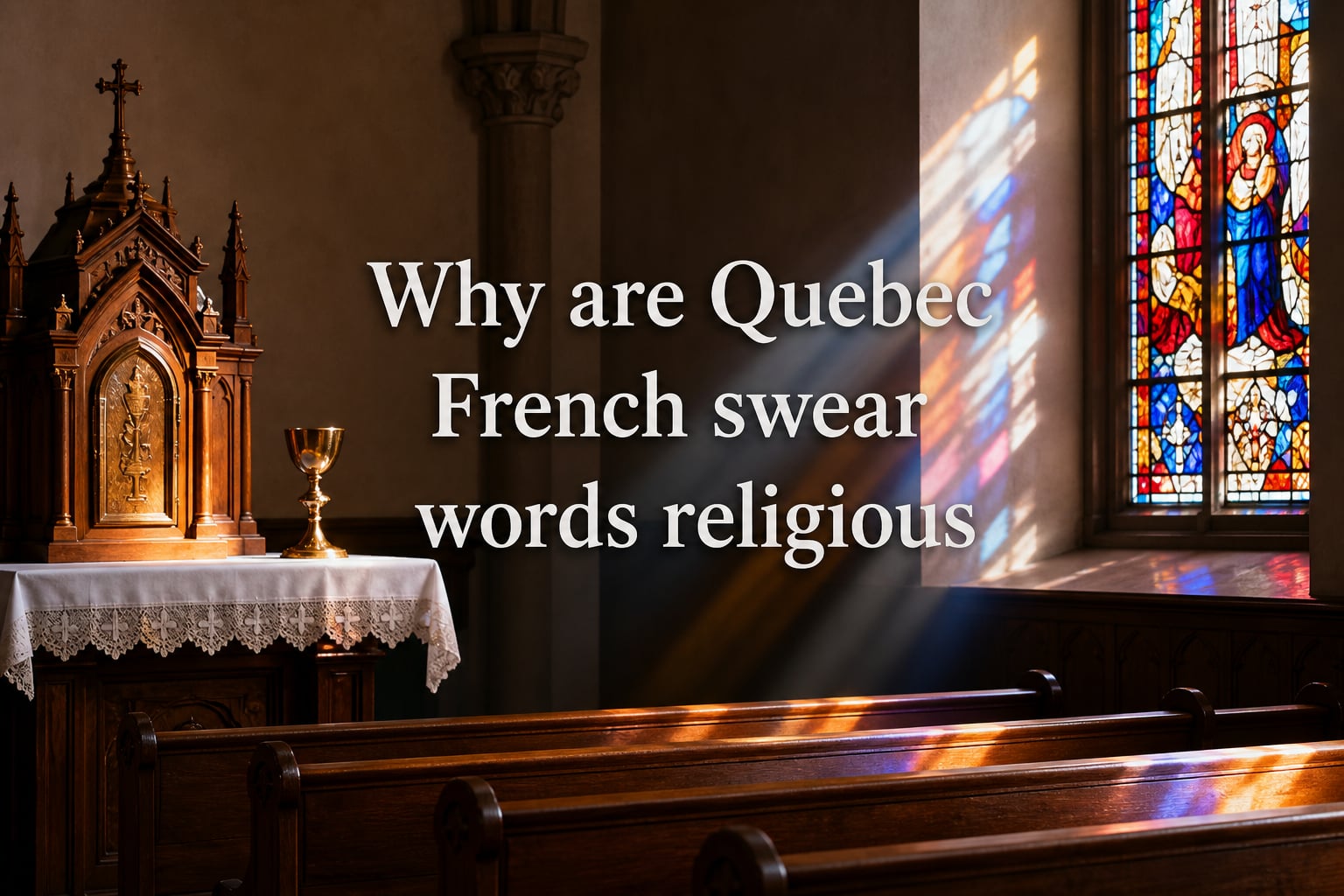
Quebec French swear words are religious because the Catholic Church dominated every aspect of Quebecois life for over 300 years, making Catholic liturgical terms the most powerful and taboo words available. When Quebecers needed language strong enough to express anger, frustration, or shock, they reached for the vocabulary of the institution that held ultimate authority over their lives: the Church. These religious-based profanities, known as sacres, turn holy objects and rituals into curse words, and they exist nowhere else in the French-speaking world with such intensity.
If you’ve ever heard a Quebecer hit their thumb with a hammer and shout “tabarnak!”, you might have wondered why a word for a church cabinet carries such force. The answer reveals a fascinating story about colonial history, clerical power, cultural rebellion, and the psychology of taboo. In this guide, we’ll explore why Quebec French swear words are religious, trace the history from New France to the Quiet Revolution, and break down the most common sacres and what they mean.
Table of Contents
- What Are Sacres? Quebec’s Unique Profanity System
- The Catholic Church’s Grip on Quebec: A Historical Overview
- How Catholic Liturgical Terms Became Swear Words
- Common Quebec French Swear Words and Their Catholic Origins
- The Quiet Revolution: When Quebec Broke Free from the Church
- Modern Usage: Are Sacres Still Understood Today?
- Quebec vs. European French Swearing: A Striking Contrast
- FAQs
- Conclusion
What Are Sacres? Quebec’s Unique Profanity System
Sacres (singular: sacre) are Quebec French swear words derived from Catholic liturgical terminology. The word itself comes from the French verb sacrer, meaning “to consecrate” or “to make holy.” In a deeply ironic twist, Quebecers took the most sacred vocabulary in their language and weaponized it as profanity.
What makes sacres remarkable is how completely they dominate Quebec’s swearing vocabulary. In most languages, profanity draws from a mix of sources: bodily functions, sexual acts, family insults, and religion. In Quebec French, the strongest and most offensive swear words are almost exclusively religious. This sets Quebec apart from every other French-speaking region on earth.
In France, the most common swear words (putain, merde, connard) are sexual or scatological. A Parisian might blaspheme with nom de Dieu, but those words carry relatively mild force compared to their Quebec equivalents. In Quebec, the religious sacres sit at the absolute top of the profanity hierarchy. Nothing hits harder than a well-placed calice or tabarnak.
This system is so culturally specific that linguists study it as a unique phenomenon. No other French dialect has built its entire swear-word lexicon around church objects. The sacres are living artifacts of Quebec’s turbulent relationship with the Catholic Church, and understanding them means understanding Quebec’s history itself.
The Catholic Church’s Grip on Quebec: A Historical Overview
To understand why Quebec French swear words are religious, you have to understand how deeply the Catholic Church embedded itself in Quebec society. When Samuel de Champlain founded Quebec City in 1608, the Catholic Church arrived with the first colonists. For the next three and a half centuries, the Church would be the single most powerful institution in Quebecois life.
New France was a Catholic colony from the start. The French Crown and the Catholic Church worked together to build a society where faith and daily life were inseparable. Priests accompanied explorers, missionaries converted (or attempted to convert) Indigenous peoples, and religious orders established the colony’s first schools and hospitals. The Church wasn’t just a Sunday affair. It was the backbone of civilization in New France.
After the British conquered New France in 1760, something unexpected happened. Rather than suppressing Catholicism, the British allowed the Church to continue operating through the Quebec Act of 1774. This decision effectively gave the Catholic Church a monopoly over the spiritual, educational, and social life of French Canadians. With no French aristocracy left to lead the community, the clergy stepped into the vacuum.
By the late 1800s and early 1900s, the Church’s control was nearly absolute. The clergy ran the school system, managed hospitals, oversaw charities, and influenced elections. Bishops and priests decided what was morally acceptable, what children learned, and how communities functioned. Historian Claude Belanger of Marianopolis College noted that “without a doubt, the social institution that exercised the greatest influence, and had the most impact on Quebec, was the Roman Catholic Church.”
The Church also promoted an ideology that historian Denis Moniere described as rooted in “agriculturalism, messianism, and anti-communism.” French Canadians were taught that their survival as a Catholic people depended on large families, obedience to the clergy, and resistance to secular modernity. The famous phrase la revanche des berceaux (“the revenge of the cradles”) captured this philosophy: French Canadians would outbreed English-speaking Protestants, and the Church would guide every one of those children.
When an institution holds this much power over every person’s life, its vocabulary becomes emotionally charged in ways that everyday words are not. Church language was the language of authority, fear, guilt, and salvation. That emotional charge is exactly what makes a word effective as profanity.
How Catholic Liturgical Terms Became Swear Words
Swearing works by breaking taboos. The power of a swear word comes from the social prohibition against saying it. In a society where the Catholic Church defined what was sacred and untouchable, the most powerful taboos were religious ones. Taking a holy word and using it in anger or frustration was an act of sacrilege, and that’s precisely what gave the word its shock value.
The transformation of liturgical terms into profanities likely built up gradually over centuries. Quebecois people lived in a world saturated with Catholic ritual. They heard words like tabernacle, calice, and hostie every Sunday at Mass. These words were treated with reverence and awe. The communion wafer, for instance, was believed to literally become the body of Christ through transubstantiation. To take that word and shout it in anger was to violate something deeply sacred.
Some linguists trace the phenomenon partly to a Protestant influence. In Calvinist and other Protestant traditions, the Catholic mass was viewed as idolatrous, and Catholic ritual objects were seen as objects of mockery rather than reverence. French Protestants (Huguenots) who encountered Catholic liturgy sometimes used Catholic terms derisively. This anti-Catholic mockery may have contributed to a broader cultural pattern of treating Catholic objects as legitimate targets for verbal abuse. While Quebec itself was overwhelmingly Catholic, the broader French-speaking world included this Protestant undercurrent, and the habit of mocking Catholic objects found fertile ground in Quebec’s particular social conditions.
There’s also a psychological dimension. Religious fear and guilt are powerful emotions. When a Quebecer stubs their toe and screams a sacre, they’re tapping into centuries of conditioning that says these words are dangerous and forbidden. The word feels explosive precisely because the culture taught generations of people to treat it with dread. Olivier Bauer, a professor at the Universite de Montreal who has studied Quebec’s religious vocabulary extensively, has pointed out that the sacres carry an emotional weight that purely secular words cannot match.
Anti-clerical resentment also played a role. Not everyone in Quebec loved the Church. For many working-class Quebecers, the clergy represented control, judgment, and oppression. Using the Church’s own sacred vocabulary as a weapon against it was a form of rebellion. Every tabarnak hurled in frustration was, on some level, a small act of defiance against the institution that demanded obedience in every other corner of life.
Common Quebec French Swear Words and Their Catholic Origins
The Quebec French swear words that come from Catholic terminology cover the full range of church objects and rituals. Each one has a specific liturgical meaning that has been stripped of its holiness and repurposed as an expletive. Here are the most important sacres and what they originally meant.
Tabarnak (from tabernacle): The tabernacle is the locked box on or behind the altar where consecrated communion wafers are stored. In Catholic theology, it houses the literal body of Christ. As a swear word, tabarnak is one of the strongest sacres in Quebec French. It’s versatile and can express extreme anger, pain, or surprise.
Calice (from calice, meaning “chalice”): The chalice is the sacred cup used to hold wine during the Eucharist. As a profanity, calice is common and forceful, often shortened to calisse in spoken Quebec French. You’ll hear it used similarly to “damn” or stronger English expletives, depending on context and intensity.
Ostie (from hostie, meaning “host” or communion wafer): The communion host is the unleavened bread that Catholics believe becomes the body of Christ during Mass. The swear word ostie (also spelled esti or asti) is one of the most frequently used sacres. It’s versatile enough to serve as a standalone exclamation or to modify other words.
Crisse (from Christ): A phonetic spelling of “Christ,” this sacre is used as a general intensifier. You might hear someone described as fant en crisse (fed up) or tiguidou en crisse. While using “Christ” as an expletive exists in English too, in Quebec it carries the full force of the sacres system.
Ciboire (from ciboire, meaning “ciborium”): The ciborium is the vessel that holds communion wafers, similar to the tabernacle but typically used during the actual distribution of communion. As a swear word, ciboire is slightly less common than the top three but still packs significant punch.
Sacrement (from sacrement, meaning “sacrament”): A sacrament in Catholic theology is a sacred ritual instituted by Christ. There are seven sacraments, including baptism, communion, and marriage. As a profanity, sacrement is strong and sometimes used to amplify other sacres in compound expressions.
Quebecers also combine these words into elaborate strings called jurons. A particularly angry Quebecer might unleash a chain like ostie de tabarnak de calisse, stacking sacres on top of each other for maximum impact. These combinations can become almost poetic in their creativity, and they demonstrate how deeply embedded the Catholic vocabulary is in the emotional language of Quebec French.
The Quiet Revolution: When Quebec Broke Free from the Church
The 1960s marked a dramatic turning point in Quebec history. A period known as the Quiet Revolution (Revolution tranquille) swept through the province, transforming it from one of the most religious societies in North America to one of the most secular. This shift is essential to understanding how Quebec’s religious swear words evolved from living expressions of faith into purely profane terms.
Before 1960, the Catholic Church ran Quebec’s schools, hospitals, and social services. Nuns and priests taught the children, managed the sick, and shaped public morality. The Church’s influence was so complete that it defined what it meant to be French Canadian. To be canadien-francais was to be Catholic, full stop.
That all changed rapidly. In 1960, the Liberal government under Jean Lesage took power and began aggressively secularizing Quebec’s institutions. The state took control of education from the Church. The Ministry of Education was created in 1964, replacing the Catholic and Protestant school commissions that had run the system. Hospitals passed from religious orders to public administration. Hydro-Quebec was nationalized, and the government invested heavily in modernizing the economy.
Church attendance, which had been near-universal in the 1950s, plummeted. Religious vocations collapsed. The clergy’s moral authority evaporated within a single generation. Quebec went from having one of the highest rates of Mass attendance in the world to having some of the lowest, in a transformation that sociologists describe as one of the most rapid secularizations in modern history.
Here’s what’s fascinating: the swear words survived the revolution that stripped the Church of its power. The sacres remained even after the institution that gave them meaning lost its grip. But their nature changed. Before the Quiet Revolution, a sacre was genuine blasphemy, a violation of something people genuinely held sacred. After the Quiet Revolution, the words lost their religious sting for many speakers and became simply the accepted vocabulary for expressing strong emotion.
This is why the sacres exist in such an interesting cultural space today. They are relics of a religious world that Quebec has largely left behind, yet they remain the strongest words in the language. They outlived the culture that created them.
Modern Usage: Are Sacres Still Understood Today?
Walk through Montreal in 2026 and you’ll still hear sacres on the street. But the way Quebecers use and understand these words has shifted dramatically, especially across generations. The religious meaning that once made these words so explosive is fading for many young speakers.
Older Quebecers who grew up attending Catholic schools and serving at Mass understand exactly what a tabernacle or a ciborium is. For them, the sacres still carry a trace of their original sacrilegious force. They know what they’re saying, and they know why it’s offensive. The words connect to a living memory of the Church’s dominance.
Younger Quebecers tell a different story. Many people under 40 have never regularly attended Mass and have only a vague idea of what these Catholic objects actually are. Forum discussions on Reddit’s r/Quebec reveal that some young Quebecers literally don’t know the religious definition of hostie or ciboire. For them, these are simply powerful swear words, not profaned holy objects. The words have been hollowed out of their original meaning and function as pure sound-based expletives.
At the same time, English swear words have been making heavy inroads into Quebec. Young Quebecers increasingly pepper their speech with “fuck,” “shit,” and English-derived expressions. Some linguists and cultural commentators worry that the traditional sacres are slowly being displaced. The unique religious profanity system that defined Quebec French for centuries may be gradually fading into a more homogenized, English-influenced swearing culture.
Yet the sacres persist as markers of cultural identity. Using them signals that you belong to Quebec, that you share its particular history and linguistic heritage. They appear in Quebec cinema, music, and literature as authentic expressions of the culture. Films like Bon Cop, Bad Cop deploy sacres with pride, and comedians build entire routines around the creative possibilities of stacking jurons. Even as their religious meaning fades, the sacres remain unmistakably and proudly Quebecois.
Quebec vs. European French Swearing: A Striking Contrast
The difference between Quebec French and European French profanity is one of the most striking contrasts in the French-speaking world. It surprises many learners and travelers who expect the two varieties of French to share the same swear words.
In France, the go-to swear words are overwhelmingly sexual and scatological. Putain (whore), merde (shit), connard (asshole), and bordel (brothel) dominate everyday French cursing. Religious words like nom de Dieu (God’s name) or bon Dieu exist, but they carry relatively mild force. A French person might use nom de Dieu the way an English speaker uses “gosh,” barely registering it as a real swear.
In Quebec, the hierarchy is inverted. The sacres, all drawn from Catholic vocabulary, are the most offensive words in the language. Meanwhile, sexual and scatological terms like putain or merde are considered milder and less shocking than they are in France. A Quebecer might use merde relatively casually but reserve calice for moments of genuine emotional intensity.
This divergence exists because France and Quebec had radically different relationships with the Catholic Church. France underwent secularization gradually, starting with the French Revolution in 1789 and continuing through the 19th and 20th centuries. By the time modern France emerged, the Church had been a contested institution for over a century. Religious words lost their taboo power slowly and naturally.
Quebec’s experience was entirely different. The Church maintained total dominance until a sudden rupture in the 1960s. Because the Church’s power was so absolute for so long, its vocabulary became the most emotionally loaded language available. When Quebecers needed the strongest possible words, they naturally reached for the vocabulary of the institution that loomed largest in their lives. No other French-speaking community experienced this particular combination of extreme clerical dominance and the need for a powerful profanity vocabulary.
FAQs
Where do Quebec swear words come from?
Quebec swear words, known as sacres, come from Catholic liturgical terminology. Words like tabarnak (tabernacle), calice (chalice), and ostie (communion host) originated as sacred church objects that became profanities because the Catholic Church dominated Quebec society for over 300 years, making its vocabulary the most emotionally powerful and taboo language available.
Why is tabernacle a swear in Quebec?
Tabernacle became a swear word in Quebec because it refers to the locked box on a Catholic altar that houses consecrated communion wafers, which Catholics believe become the literal body of Christ. In a society where the Catholic Church controlled daily life, taking this sacred object’s name and using it in anger was a profound act of sacrilege, giving the word enormous shock value as a profanity.
What is the most offensive French swear word?
In Quebec French, the most offensive swear words are the sacres, with tabarnak and calice generally considered the strongest. In European French, the most offensive words are sexual or scatological terms like putain and connard. The most offensive word depends on which variety of French you are speaking, since Quebec and France have completely different profanity hierarchies.
Is Quebec still very Catholic?
No, Quebec is no longer very Catholic. The Quiet Revolution of the 1960s triggered one of the most rapid secularizations in modern history. Church attendance dropped from near-universal levels in the 1950s to among the lowest in North America today. Quebec is now one of the most secular societies in the Western world, even though the religious sacres remain in use as swear words.
Conclusion
So why are Quebec French swear words religious? Because for over 300 years, the Catholic Church was the most powerful, most feared, and most omnipresent institution in Quebecois life. Its vocabulary was charged with more emotional weight than any other words in the language. When Quebecers needed language strong enough to express the strongest emotions, they naturally reached for the words that carried the most taboo power: the sacred objects and rituals of the Church that controlled their world.
The sacres are linguistic fossils of a vanished society. They emerged from a world where the Church ran the schools, the hospitals, and the moral order. They gained their force from genuine religious belief and genuine fear of sacrilege. Then the Quiet Revolution swept that world away in a single decade, and the words were left behind, still explosive but increasingly disconnected from their original meaning.
Today, the sacres stand as a unique cultural treasure. No other French-speaking community curses like Quebec, and no other language on earth has built such a complete profanity system around the objects of a single faith. Understanding why Quebec French swear words are religious means understanding the entire arc of Quebec’s history, from colonial roots through clerical domination to modern secular identity. These words carry centuries of history in every syllable, and that’s exactly why they still hit so hard.