
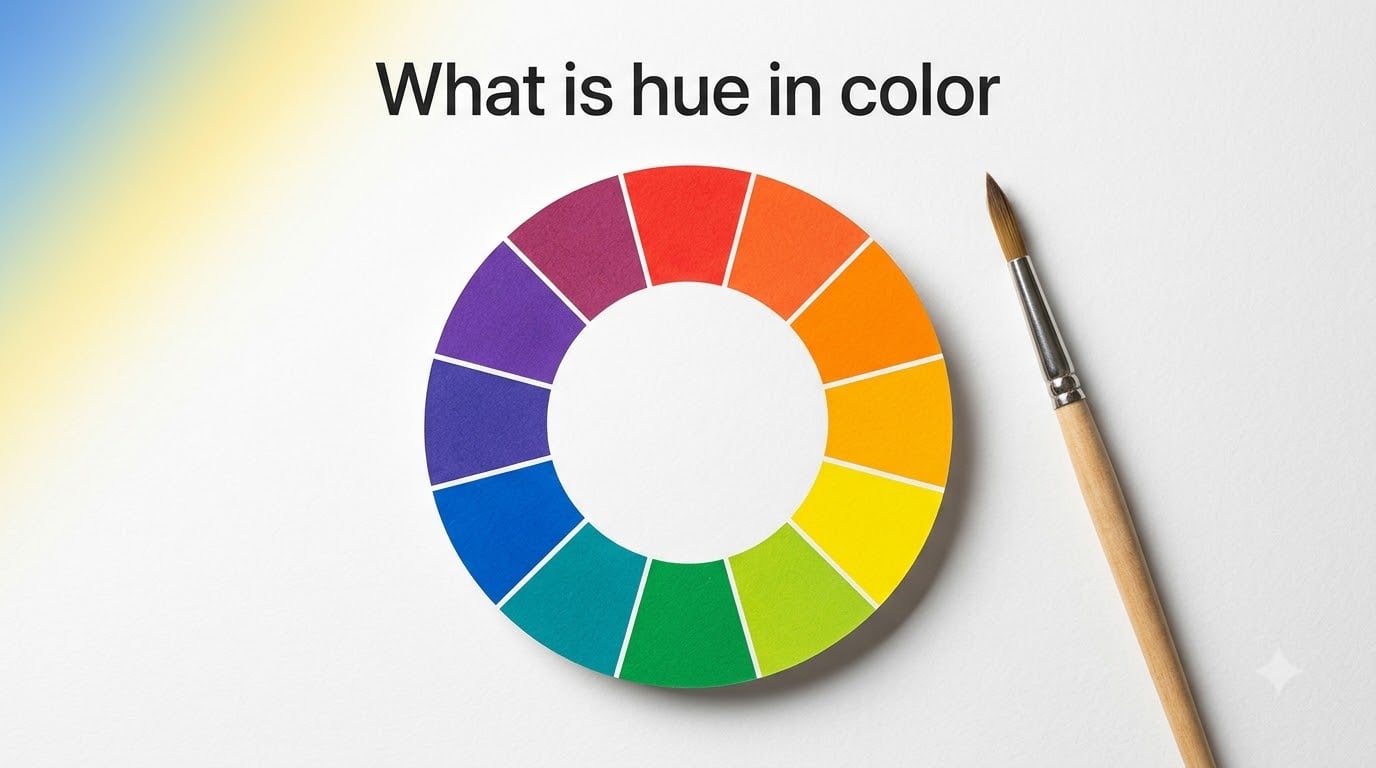
A hue is the basic family or pure identity of a color, such as red, blue, yellow, or green. It is the specific name you give a color based on where it sits on the color wheel, and it exists independent of how light, dark, bright, or dull that color appears.
If you have ever wondered what is hue in color and why artists and designers talk about it so much, you are in the right place. I have spent years working with color in both digital design and traditional painting, and I want to share a clear, beginner-friendly explanation that actually sticks.
By the end of this guide, you will understand exactly what hue means, how it relates to other color terms like tint, shade, tone, saturation, and value, and how to identify hues in everything from your favorite painting to the pixels on your screen.
Table of Contents
What Is Hue in Color
Hue is the pure, unmixed color family that forms the foundation of every color we see. When someone points at a swatch and says “that is red” or “that is teal,” they are identifying the hue. The word itself comes from the Old English term for appearance or form, which makes sense because hue is what gives a color its recognizable identity.
Think of hue as the color’s first name. Before you describe how saturated or how light it is, you name the hue. Red is a hue. Blue is a hue. Even purple, orange, and pink are hues. What is not a hue is the white added to make pink lighter, the black added to make maroon darker, or the gray that dulls any color into a muted version.
According to Wikipedia’s color theory entry, in traditional painting a hue refers to a pure pigment without added tint or shade. This definition captures the essential idea: hue is the starting point before any modification.
How Hue Works on the Color Wheel
Hue lives on the color wheel, and its position is what defines which hue it is. The standard color wheel organizes hues in a circle so that related colors sit next to each other and contrasting colors sit across from one another.
The 12 Hues of the Color Wheel
The traditional color wheel contains 12 hues, divided into three groups:
- Primary hues: Red, yellow, and blue. These cannot be created by mixing other hues together.
- Secondary hues: Orange, green, and purple. Each one is made by mixing two primary hues in equal parts.
- Tertiary hues: Yellow-orange, red-orange, red-purple, blue-purple, blue-green, and yellow-green. These come from mixing a primary hue with an adjacent secondary hue.
Once you understand these 12 anchor points, every other color you encounter falls somewhere between them on the wheel.
Measuring Hue in Degrees
In digital color systems, hue is measured as an angle from 0 to 360 degrees around the color wheel. This gives every hue a precise numerical position:
- Red sits at 0 degrees
- Yellow sits at 60 degrees
- Green sits at 120 degrees
- Cyan sits at 180 degrees
- Blue sits at 240 degrees
- Magenta sits at 300 degrees
This degree measurement is what lets software like Photoshop, Illustrator, and every design tool manipulate hue with mathematical precision. When you adjust the hue slider by 30 degrees, you shift the color by one-fifth of the way around the wheel.
Hue vs Tint vs Shade vs Tone
This is where many beginners get confused, because tint, shade, and tone are all variations of a hue. Understanding the difference is essential for working with color in any medium.
| Term | What It Is | How to Make It |
|---|---|---|
| Hue | The pure color family | Start with a single pigment or color value |
| Tint | Hue mixed with white | Add white to lighten the hue |
| Shade | Hue mixed with black | Add black to darken the hue |
| Tone | Hue mixed with gray | Add gray to dull the hue |
Here is a simple example. Take pure red as your hue. Add white and you get pink, which is a tint of red. Add black and you get maroon, which is a shade of red. Add gray and you get a muted, dusty red, which is a tone of red.
The original hue stays the same throughout. What changes is the value or saturation of that hue based on what you mixed in.
Hue vs Saturation vs Value
Color theory breaks every color down into three measurable properties: hue, saturation, and value. These are often called the three elements of color, and understanding each one separately gives you complete control over any color you work with.
| Element | What It Controls | Example Comparison |
|---|---|---|
| Hue | The color family or identity | Red vs. blue vs. yellow |
| Saturation | The intensity or purity | Vivid red vs. faded red |
| Value | The lightness or darkness | Light pink vs. dark crimson |
Saturation refers to how pure or intense a color appears. A fully saturated hue looks vivid and bright, while a desaturated hue looks muted or grayish. Imagine a fire-engine red versus a dusty rose. Same hue family, very different saturation levels.
Value refers to how light or dark a color is. Adding white raises the value, adding black lowers it. A sky blue has high value, while a navy blue has low value. Both are blue hues, but they sit at opposite ends of the value scale.
When you change the hue, you change the color family. When you change saturation, you change how pure it looks. When you change value, you change how light or dark it appears. These three properties work independently, which is why a single hue can produce thousands of distinct colors.
Which Colors Are Not Hues
Pure white, pure black, and pure gray are not hues. These colors are called achromatic, meaning they have no color family at all. They contain no identifiable red, blue, yellow, or any other hue component.
This is a common source of confusion. White looks bright and black looks bold, so why are they not hues? The answer lies in what defines a hue. A hue must be a recognizable color family from the visible spectrum. White contains all wavelengths of light at once, while black contains none. Gray sits somewhere in between, with equal amounts of all wavelengths.
Brown is also interesting. Brown is not on the traditional color wheel, but it is technically a low-saturation, low-value orange or red hue. When you mix a bright orange hue with gray or black, you get brown. So brown is a tone or shade of an underlying hue, not a hue itself.
Practical Examples of Hue in Everyday Life
Hue is not just an art theory concept. You see and use hues every single day, often without thinking about it. Here are some practical examples that make the concept click.
Hue in Nature
Look outside your window. The sky on a clear day shows a blue hue. The grass in your lawn shows a green hue. A ripe tomato shows a red hue. Each one of these is a hue because each has a recognizable color family identity.
When the sky shifts to pink at sunset, the hue is still in the red family, but the saturation and value have changed. The grass turning yellow in autumn is a hue shift from green to yellow, not just a change in saturation.
Hue in Digital Design
Every website, app, and digital image you see is built on hue values. Designers choose a brand’s primary hue and then create variations by adjusting saturation and value. A typical brand palette might include one main hue plus several tints, shades, and tones of that same hue.
When you use the hue slider in Photoshop or any design tool, you are rotating the color around the color wheel by a specified number of degrees. Designers use this to create color harmony, fix color casts in photos, or generate entirely new color schemes.
Hue in Branding and Marketing
Companies spend enormous resources choosing brand hues because different hues trigger different psychological responses. Red hues tend to feel energetic and urgent, which is why many food chains and clearance sales use them. Blue hues feel trustworthy and calm, which is why banks and tech companies favor them. Green hues feel natural and balanced, which is why health and eco-friendly brands choose them.
Once a brand picks its primary hue, the marketing team builds the entire visual identity around that color family, using tints and shades for backgrounds and accent areas.
Hue in Painting and Digital Design
The way you work with hue depends on whether you are using physical pigments or digital pixels. The concept stays the same, but the tools and techniques differ.
Hue in Traditional Painting
When painters buy a tube of paint labeled “cadmium red,” they are buying a specific hue. Most paint manufacturers organize their color charts by hue family, then offer tints, shades, and tones within each family. Some paint tubes are even labeled “hue” to indicate they are synthetic alternatives to expensive natural pigments, like “cobalt blue hue” or “cadmium yellow hue.”
When mixing paints, you combine hues to create new hues. Mixing yellow and blue gives you green, a new hue on the color wheel. Mixing complementary hues across from each other on the wheel tends to produce neutral browns and grays, because the colors cancel each other’s intensity.
Hue in Digital Color Models
Digital design uses several color models, and most of them include hue as a key component. The HSL model stands for Hue, Saturation, and Lightness. The HSV model stands for Hue, Saturation, and Value. Both give you direct numerical control over each property.
This is a huge advantage over painting. In Photoshop, you can enter the exact hue degree you want, adjust the saturation percentage, and set the lightness or value level. The software calculates the resulting color instantly. A painter mixing physical pigments would need much more trial and error to land on the same result.
Hue shift is another powerful digital tool. Photographers use it to correct unwanted color casts, and graphic designers use it to create cohesive color schemes from a single starting hue.
Frequently Asked Questions
What is hue and saturation?
Hue is the pure color family of a color, like red, blue, or green. Saturation is the intensity or purity of that hue. A fully saturated color looks vivid and bright, while a desaturated color looks muted or grayish. For example, fire-engine red is a highly saturated red hue, while dusty rose is a low-saturation version of the same red hue.
Why is it called hue?
The word hue comes from the Old English word hīew, meaning appearance or form. Over time, it came to specifically mean the property of color that lets us identify it as red, blue, green, or another family. It is related to the word ‘shape’ in some ancient Germanic languages, reflecting how hue shapes a color’s identity.
What colors have no hue?
Pure white, pure black, and pure gray have no hue. These colors are called achromatic, meaning they lack a specific color family identity. White contains all wavelengths of visible light at once, black contains none, and gray contains equal amounts of all wavelengths. Brown is not a hue either, but it is a low-saturation, low-value version of orange or red.
Is blue a color or a hue?
Blue is both a color and a hue. In color theory, hue refers to the base color family, and blue is one of the primary hues on the color wheel. Every specific shade of blue, from sky blue to navy, shares the same blue hue but differs in saturation and value.
What is meant by hue in color?
Hue means the basic color family or pure identity of a color. It is what you name when you point at a color and say it is red, orange, yellow, green, blue, or purple. Hue is one of the three main properties of color, along with saturation and value, and it forms the foundation of all color theory.
What are the 12 hues of color?
The 12 hues of the color wheel are red, red-orange, orange, yellow-orange, yellow, yellow-green, green, blue-green, blue, blue-purple, purple, and red-purple. These include 3 primary hues, 3 secondary hues, and 6 tertiary hues that fill the spaces between them.
What is the difference between hue value and saturation?
Hue, value, and saturation are three separate properties of color. Hue is the color family (red, blue, green). Value is how light or dark the color is, controlled by adding white or black. Saturation is how intense or pure the color appears, controlled by how much gray is mixed in. Changing any one of these three properties changes how the color looks while leaving the other two unchanged.
Final Thoughts on What Is Hue in Color
Understanding what is hue in color gives you a foundation for everything else in color theory. Hue is the pure color family, measured by its position on the color wheel and expressed in degrees from 0 to 360. It is the starting point before you adjust saturation, value, tint, shade, or tone.
Once you grasp hue as a separate property from those other qualities, choosing and combining colors becomes much more intuitive. Whether you are painting a landscape, designing a website, or just picking out a wardrobe, thinking in terms of hue first will sharpen every color decision you make.
I encourage you to grab a color wheel or open a digital color picker and start experimenting. Pick a single hue and explore how many different colors you can create just by adjusting its saturation and value. That hands-on practice will cement the concept faster than any amount of reading.